
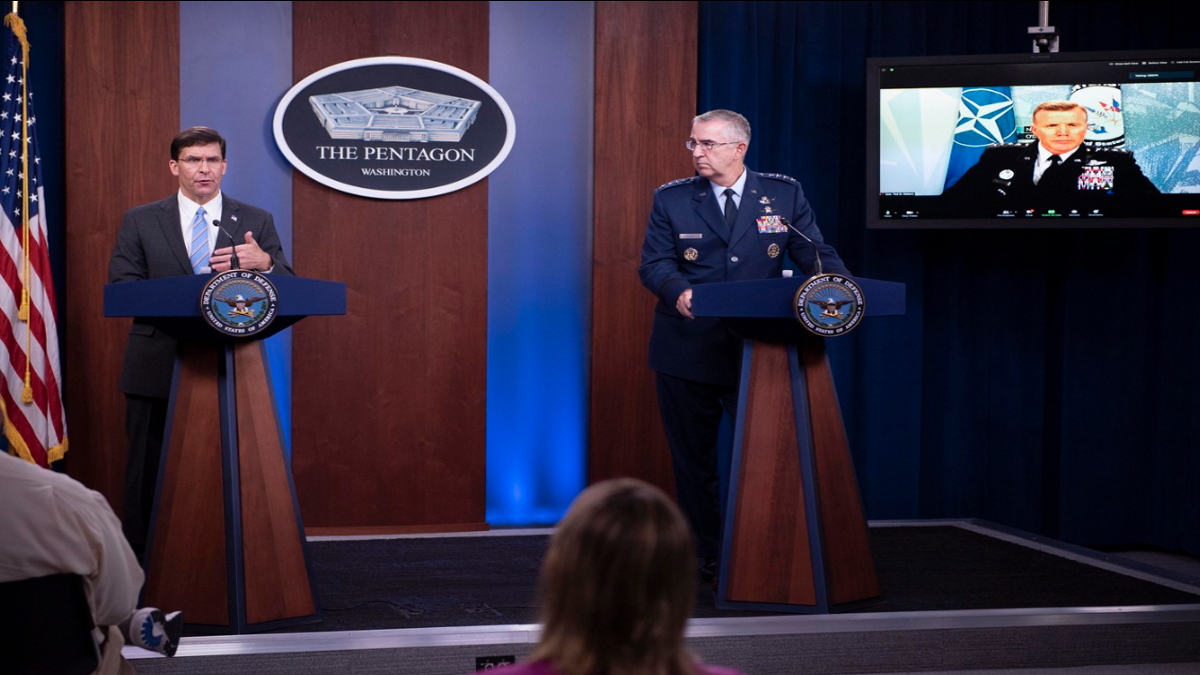
The United States will bring some American service members home from their forward stationed assignments in Germany, while other service members will move to other locations in Europe to improve the commitment to NATO and the defense of Europe, Defense Secretary Dr. Mark T. Esper said, adding that the proposed changes are firmly in line with the National Defense Strategy.
The plan is for U.S. European Command to reposition 11,900 personnel who are currently stationed in Germany to other locations, Esper said during a news conference today at the Pentagon. The move will reduce the number of U.S. military personnel in Germany from about 36,000 to 24,000. Repositioning could begin in weeks, he said, adding that with 24,000 American service members, Germany would still host the highest number of U.S. troops of any nation in NATO.
About 5,600 service members being moved out of Germany will stay within Europe. They will be moved to other NATO nations, Esper said. An additional 6,400 personnel will return to the United States, though Esper said this will not mean less support of NATO allies, because instead of having permanently stationed forces in Germany, other military units will begin rotational deployments farther east on the continent in more strategic locations, such as near the Black Sea region.
”Our aim is to implement these moves as expeditiously as possible consistent with the principles I set forth from the beginning, particularly being fair to, and taking care of our service members and their families,” the secretary said. ”We could see some moves begin within weeks. Others will take longer. As anyone can see, the repositioning of our forces in Europe constitutes a major strategic and positive shift, wholly in line with the NDS and consistent with other adjustments the United States has made within NATO in previous times.”
Air Force Gen. Tod D. Wolters, commander of U.S. European Command and NATO’s supreme allied commander for Europe, spelled out some of the specific movements planned for forces in Europe.
The Eucom headquarters and the associated U.S. Special Operations Command-Europe headquarters, for example, would move from Germany to Mons, Belgium, where they would be located with Supreme Headquarters Allied Powers Europe.
”This will improve the speed and clarity of our decision-making and promote greater operational alignment,” Wolters said, adding that a similar relocation could happen for U.S. Africa Command headquarters and the associated U.S. Special Operations Command-Africa, though no new location has been determined.
Wolters also said Eucom intends to reposition three brigade-sized headquarters, an air defense artillery battalion, and an engineering battalion to Belgium from Germany, as well as move two smaller support and contracting organizations to Italy. He said the 52nd Civil Engineering Squadron, an Air Force unit, could be one of the first to move. The plan is to put that unit in Italy.
Eucom also proposes relocating an F-16 fighter squadron and elements of a fighter wing to Italy. Esper said the move will put those units closer to the Black Sea region, better enabling them to support NATO in the southeast.
”The proposal to reposition forces back to [the United States], … with respect to the 2nd Cavalry Regiment, will allow those units to regain maximum U.S. at-home-station readiness and more effectively support global contingencies while still maintaining a keen focus on Europe,” Wolters said.
There are also plans to rotate forward the lead element of the Army’s 5th Corps headquarters to Poland, Esper said, contingent on Warsaw signing a defense cooperation agreement. There may also be other opportunities to move additional forces into Poland and the Baltics, the general said.
”This rebalance, consistent with the NDS, will align NATO and Eucom capabilities, better distribute forces across Europe and increase the use of rotational forces, thus bolstering our commitment to Europe,” said Air Force Gen. John E. Hyten, vice chairman of the Joint Chiefs of Staff. ”It enhances deterrence and improves operational flexibility. Repositioning our forces and making consolidations will provide General Wolters, as the commander, increased ability to dynamically employ his force. This effort will increase opportunities to partner with and strengthen our bond with allies and partners in the region. It will also require additional planning and consultation with our allies.”
Blogs to Follow:
- Conservative Firing Line
- Adina Kutnicki — A Zionist and Conservative Blog
- Allen West Republic
- Hot Air
- Liberty Unyielding
- Newsbusters
- The Liberty Daily
- Twitchy
- Whatfinger News
- Wayne Dupree
CBP.gov (July 2020) DOD Proposes Removing More than 11,000 Troops From Germany


 Law Enforcement, Military, and Terrorism News