
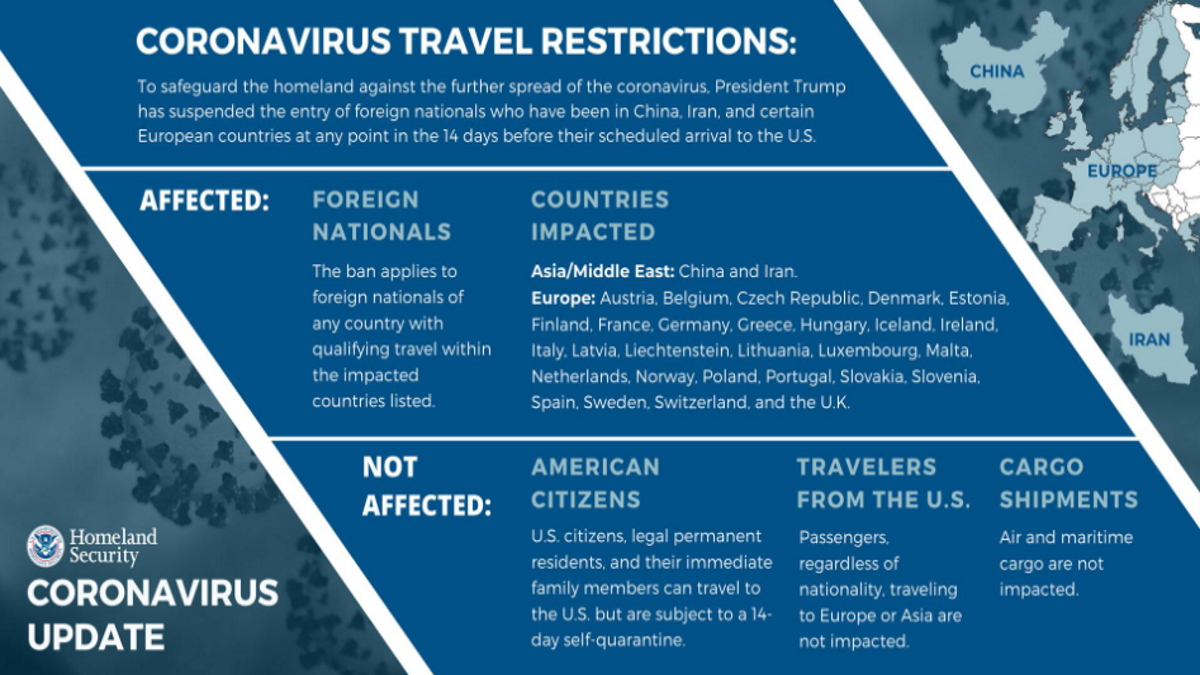
In furtherance of Presidential Proclamations 9984, 9992, 9993, and 9994, which bans the entry of non-U.S. citizens who are from or recently been in China, Iran, or certain European countries, the Department of Homeland Security issued a Notice of Arrival Restrictions requiring American citizens, legal permanent residents, and their immediate families who are returning home to the U.S. to travel through one of 13 airports upon arrival to the U.S., submit to an enhanced entry screening and self-quarantine for 14 days once they reach their final destination.
On March 11, 2020, President Trump determined that the potential for widespread transmission of the coronavirus by infected individuals seeking to enter the United States threatens the security of the homeland. The President issued Proclamations 9984, 9992, and 9993, which suspends entry to nearly all foreign nationals who have been in China, Iran, and certain European countries at any point during the 14 days prior to their scheduled travel to the U.S.

These European countries include: Austria, Belgium, Czech Republic, Denmark, Estonia, Finland, France, Germany, Greece, Hungary, Iceland, Ireland, Italy, Latvia, Liechtenstein, Lithuania, Luxembourg, Malta, Netherlands, Norway, Poland, Portugal, Slovakia, Slovenia, Spain, Sweden, Switzerland, and the United Kingdom.
The order is now effective. Americans returning from the affected countries will now be required to travel through 13 airports:
- Boston-Logan International Airport (BOS), Massachusetts
- Chicago O’Hare International Airport (ORD), Illinois
- Dallas/Fort Worth International Airport (DFW), Texas
- Detroit Metropolitan Airport (DTW), Michigan
- Daniel K. Inouye International Airport (HNL), Hawaii
- Hartsfield-Jackson Atlanta International Airport (ATL), Georgia
- John F. Kennedy International Airport (JFK), New York
- Los Angeles International Airport, (LAX), California
- Miami International Airport (MIA), Florida
- Newark Liberty International Airport (EWR), New Jersey
- San Francisco International Airport (SFO), California
- Seattle-Tacoma International Airport (SEA), Washington
- Washington-Dulles International Airport (IAD), Virginia
Upon arrival, travelers will proceed to standard customs processing. They will then continue to an enhanced entry screening where the passenger will be asked about their medical history, current condition, and asked for contact information for local health authorities. Additionally, some passengers will have their temperature taken.
After the enhanced entry screening is complete, passengers will be given written guidance about COVID-19 and be allowed to proceed to their final destination.
Once home, individuals must immediately self-quarantine in their home and monitor their health in accordance with CDC best practices.
In order to ensure compliance, local and State public health officials will contact individuals in the days and weeks following their arrival.
DHS.gov (March, 2020) Fact Sheet: DHS Notice of Arrival Restrictions on China, Iran and Certain Countries of Europe
 Law Enforcement, Military, and Terrorism News