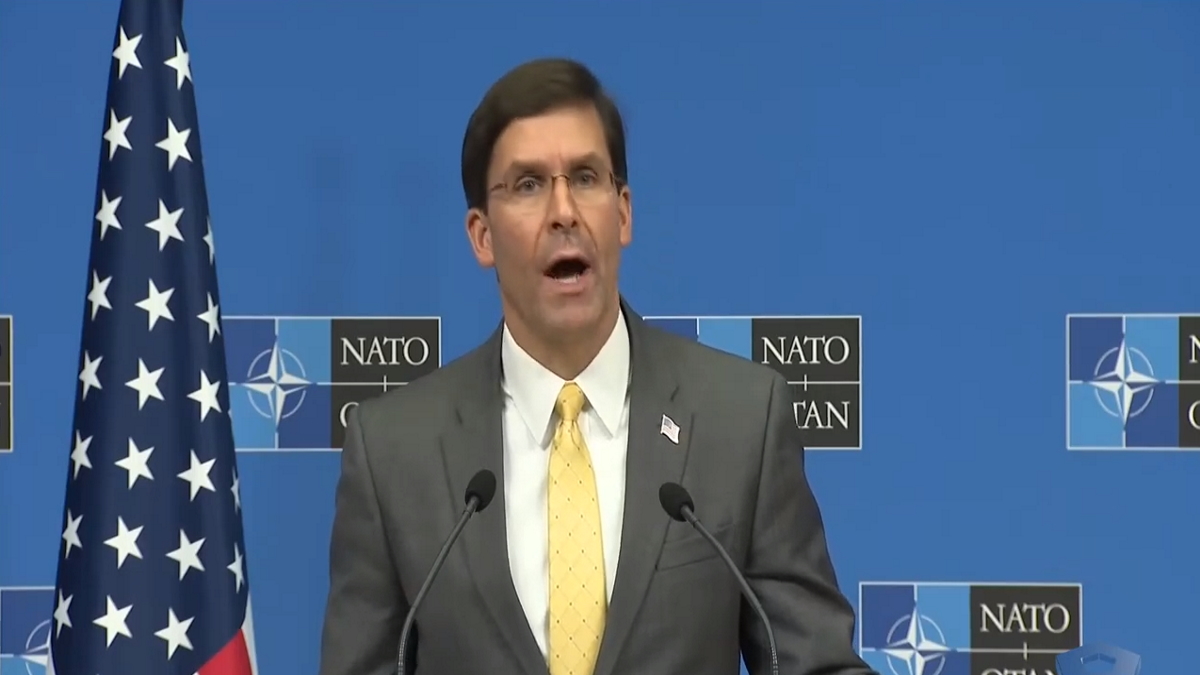
Defense Secretary Dr. Mark T. Esper’s Meetings With Counterparts From Poland, the United Kingdom, Romania and Spain

Secretary of Defense Mark T. Esper held bilateral meetings with four of his counterparts from Poland, the United Kingdom, Romania and Spain during the first day of the February 2020 NATO Defense Ministerial.


Secretary of Defense Mark T. Esper held bilateral meetings with four of his counterparts from Poland, the United Kingdom, Romania and Spain during the first day of the February 2020 NATO Defense Ministerial. 

Secretary Esper and Polish Minister of National Defence Marius Błaszczak hailed 2019 as a banner year for U.S.-Polish relations, which included two Presidential Joint Declarations on force posture and cooperative efforts in Afghanistan, Iraq and NATO’s enhanced forward presence in Latvia.

Secretary Esper thanked Poland for their contributions to defense spending and for hosting an historic DEFENDER Europe 2020 exercise later this year.

Esper then met with Minister of National Defense for Romania Nicolae-Ionel Ciucă. The leaders affirmed their commitment to ensuring security in the Black Sea region, deterring Russian aggression, and bolstering interoperability.

Secretary Esper thanked Romanians for hosting SEA SHIELD 2020 next month, which will lead to greater maritime interoperability and deeper cooperation among NATO allies and partners. He also acknowledged Romania’s positive progress on defense spending and international contributions. 

Secretary Esper and Secretary of State for Defense for the United Kingdom Ben Wallace also had an opportunity to meet and discuss their shared mission to defeat ISIS. Esper thanked the U.K. for their strong statements of commitment over the past weeks, and the U.K.’s enduring support which has allowed the coalition to navigate a number of challenges over the past several years.

Shop Amazon Gift Cards. Any Occasion. No Expiration.

Secretary Esper thanked Minister Wallace for being a steadfast and loyal ally as one of our oldest friends and partners. 

Finally, during a bilateral meeting with Minister of Defense for Spain Margarita Robles, Secretary Esper expressed his appreciation for Spain’s strong defense partnership. He urged them to honor their pledge to spend 2% of GDP on defense by 2024 and vowed to continue to partner together in our shared mission to defeat ISIS. The leaders confirmed they look forward to a continued partnership.

Secretary Esper will continue to meet with partners and allies throughout the Defense Ministerial, reaffirming the importance of strengthening the NATO alliance through readiness, ensuring more equitable burden sharing, and addressing regional security issues. 

Defense.gov(February, 2020) Readout of Defense Secretary Dr. Mark T. Esper’s Meetings With Counterparts From Poland, the United Kingdom, Romania and Spain

Guilty Plea: Soldier at Fort Riley Described How to Make Explosive Devices

Jarrett William Smith, 24, Ft. Riley, Kan., pleaded guilty today to unlawfully distributing instructions for making explosive devices over social media while he was a member of the U.S. Army, U.S. Attorney Stephen McAllister said.


Jarrett William Smith, 24, Ft. Riley, Kan., pleaded guilty today to unlawfully distributing instructions for making explosive devices over social media while he was a member of the U.S. Army, U.S. Attorney Stephen McAllister said.

Smith, described by prosecutors as a Satanist, pleaded guilty to two counts of distributing information related to explosives, destructive devices and weapons of mass destruction. Smith joined the Army June 12, 2017. He served as an infantry soldier and was trained in combat and tactical operations.

He was transferred to Fort Riley in Kansas July 8, 2019.

Shop Amazon Gift Cards. Any Occasion. No Expiration.

The FBI received information that Smith gave out guidance to others on how to construct improvised explosive devices. He spoke to others on social media about wanting to travel to Ukraine to fight with a violent, far-right military group.

On September 20, 2019, from Fort Riley Smith sent a person working undercover for the FBI specific instructions for making an explosive device. He also provided a recipe for creating improvised napalm.

Smith signed a formal plea agreement with federal prosecutors and then entered his pleas verbally during a half-hour court hearing before U.S. District Judge Daniel Crabtree. He wore an orange prison jumpsuit and black athletic shoes and alternated between “Yes” and “Yes, sir” in answering questions from Crabtree.

“Did you provide this information with the intent that the person would use it?” Crabtree asked him.

Smith replied, “Yes.”

Sentencing is set for May 18. Smith could face up to 20 years in federal prison and a fine up to $250,000 on each count. McAllister commended the FBI and Assistant U.S. Attorney Tony Mattivi for their work on the case.

Justice.gov; Armytimes.com (February, 2020) Guilty Plea: Soldier at Fort Riley Described How to Make Explosive Devices; ‘Satanist’ Fort Riley soldier pleads guilty to bomb plot charges

Perdue, Loeffler Push Fort Benning As Home Of New Army Corps Headquarters

U.S. Senator David Perdue (R-GA), a member of the Senate Armed Services Committee, and U.S. Senator Kelly Loeffler (R-GA) are urging the U.S. Army to select Fort Benning as the Army’s fourth corps headquarters.


“Fort Benning is a crown jewel of the Army uniquely qualified to host the new corps headquarters.”

U.S. Senator David Perdue (R-GA), a member of the Senate Armed Services Committee, and U.S. Senator Kelly Loeffler (R-GA) are urging the U.S. Army to select Fort Benning as the Army’s fourth corps headquarters.

The Army recently announced Fort Benning as one of three finalists to host the new headquarters, which is needed to fulfill requirements of the National Defense Strategy.

In a letter to Secretary of the Army Ryan McCarthy, Perdue and Loeffler highlighted Fort Benning’s unmatched training, support, and command facilities and its ability to quickly activate the new headquarters.  

USA Armed Forces Super Soft Fleece Throw Blanket (United States Army)

“We commend your decision to realign forces under a new corps headquarters in support of the National Defense Strategy and strongly recommend that you consider Fort Benning for its basing. Fort Benning is a crown jewel of the Army uniquely qualified to host the new corps headquarters,” the Senators said.

“Fort Benning stands ready to meet all facility, deployment support infrastructure, and community support requirements needed for activation in October 2020. As the home to the Army’s Maneuver Center of Excellence, Fort Benning provides unmatched training, support, and command facilities. It includes 26 million square feet of facilities and 102,000 acres of maneuver training areas capable of supporting all manner of maneuver operations, tactics, and training,” Perdue and Loeffler said.

Fort Benning Army post straddles the Alabama and Georgia border near Columbus, Georgia and  supports more than 120,000 active-duty military, family members, reserve component soldiers, retirees, and civilian employees on a daily basis.

View the full text of the letter here

Perdue.senate.gov (February, 2020) Perdue, Loeffler Push Fort Benning As Home Of New Army Corps Headquarters

DOD to Require Cybersecurity Certification in Some Contract Bids

By the end of September 2020, the Department of Defense (DOD) will require at least some companies bidding on defense contracts to certify that they meet at least a basic level of cybersecurity standards when responding to a request for proposals.


By the end of September 2020, the Department of Defense (DOD) will require at least some companies bidding on defense contracts to certify that they meet at least a basic level of cybersecurity standards when responding to a request for proposals.

DOD released its new Cybersecurity Maturity Model Certification on Friday, billed by the undersecretary of defense for acquisition and sustainment as “Version 1.0.”

By June, the department plans to publish as many as 10 requests for information on contracts that include CMMC requirements, Ellen M. Lord said during a Pentagon news conference announcing the certification effort. By September, she said, the department will also publish corresponding requests for proposals that include those requirements. By fiscal year 2026, all new DOD contracts will contain the CMMC requirements, Lord said.

“I believe it is absolutely critical to be crystal clear as to what expectations for cybersecurity are, what our metrics are, and how we will audit for those expectations,” Lord said. “CMMC is a critical element of DOD’s overall cybersecurity implementation.”

Lord said cybersecurity risks threaten the defense industry and the national security of the U.S. government, as well as its allies and partners. About $600 billion, or 1% of the global gross domestic product, is lost through cyber theft each year, she noted.

“Adversaries know that in today’s great-power competition environment, information and technology are both key cornerstones,” she said. “Attacking a sub-tier supplier is far more appealing than a prime [supplier].”

The CMMC gives the department a mechanism to certify the cyber readiness of the largest defense contractors — those at the top who win contracts are called “primes” — as well as the smaller businesses that subcontract with the primes.

The new CMMC provides for five levels of certification in both cybersecurity practices and processes.

“Something … simple in Level 1 would be, ‘Does your company have antivirus software? Are you updating your antivirus software? Are you updating your passwords?'” said Katie Arrington, DOD’s chief information security officer for acquisition. “CMMC Level 1 is the basic cyber hygiene skills we should be doing every day. They are there to protect yourself, your company and your own information.”

By CMMC Level 2, Arrington said, the department will also begin looking at cybersecurity processes as well, to ensure cybersecurity is not just practiced, but that a company is effectively documenting, managing, reviewing and optimizing its practices across its entire enterprise.

Arrington said that for the roughly 10 requests for information  and requests for proposals DOD is expected to publish later this year for potential contracts, she expects a mix of CMMC certification levels will be required.

“We’ll have some CMMC Level 3, CMMC Level 1, and there may be one or two with the 4 or 5 CMMC levels going out,” Arrington said.

The department will not be certifying potential defense contractors for CMMC on its own. Instead, Lord explained, a series of CMMC “third-party assessment organizations” or C3PAOs, will conduct those assessments. The C3PAOs will also not be paid by the department, Lord said. “That’s a private transaction between industrial base companies and those of certification bodies,” she added.

No C3PAOs have been designated to conduct the assessments yet, Lord said, noting that while multiple companies are interested, DOD has not yet designated who is qualified.

A newly created 13-member CMMC accreditation body, made up of members of the defense industrial base, the cybersecurity community and the academic community will oversee the training, quality and administration of the C3PAOs, Lord said.

Meanwhile, she said, the department is drafting a memorandum between DOD and the CMMC accreditation body to outline its roles, responsibilities and rules. She said one area of concern will be to ensure no conflicts of interest are involved in accreditation. For example, a C3PAO would not be able to accredit itself for CMMC.

No existing contracts with the department will have CMMC requirements inserted into them, Arrington said.

Subcontractors to a prime contractor will not all need to have the same level of CMMC certification to win a contract, Arrington said.

“Security is not one size fits all,” she added. Instead, she said, depending on how controlled unclassified information flows between those parties involved in a contract, subcontractors might need only be a CMMC Level 1 company.

CMMC will ensure a more level and fair playing field for companies bidding on DOD contracts, Arrington said. Today, she said, some small businesses bidding on work might self-attest that they meet requirements to handle certain kinds of information, but in fact only are planning to meet those requirements, while another business might actually be meeting the requirements. CMMC, she said, will ensure that only companies that actually meet requirements can compete for contracts.

“We need to make sure our industry partners are prepared to take on the work, and our third-party auditors will ensure that they are implementing the practices that we need in place to secure that national defense and our industrial base,” Arrington said.

Lord said the department is aware that CMMC requirements could be a burden to some smaller companies and that DOD is working with primes and smaller companies to help them overcome that burden.

“We need small and medium businesses in our industrial base, and we need to retain them,” she said. “We will continue to work to minimize impacts, but not at the cost of national security.”

Defense.gov (2020). DOD to Require Cybersecurity Certification in Some Contract Bids

Help me maintain this news reporting blog by donating here.

Air Force Colonel Sentenced for Receiving Child Pornography

An Air Force Colonel was sentenced today to five years in prison followed by 15 years of supervised release for receiving child pornography.


An Air Force Colonel was sentenced today to five years in prison followed by 15 years of supervised release for receiving child pornography.

Assistant Attorney General Brian A. Benczkowski of the Justice Department’s Criminal Division and U.S. Attorney G. Zachary Terwilliger for the Eastern District of Virginia made the announcement.

“According to admissions made in connection with his plea agreement, between November 2015 and June 2016, Mark Visconi, 48, received and attempted to receive child pornography using the Internet. Visconi used an online bulletin board dedicated to the sharing of child pornography that operated on the anonymous Tor network to download child pornography. A forensic review of his laptop showed that Visconi downloaded and viewed numerous child pornography images and videos.  Visconi previously pleaded guilty on Oct. 4, 2019.”

“Visconi also admitted to using his cell phone to create hundreds of apparently surreptitious pictures that were focused on the clothed buttocks of minor girls, including images that appear to have been taken with a camera angled upward underneath a minor’s skirt or loose shorts so as to depict or attempt to depict the minor’s underwear.”    

The case was investigated by U.S. Immigration and Customs Enforcement’s Homeland Security Investigations. Trial Attorney Gwendelynn Bills of the Criminal Division’s Child Exploitation and Obscenity Section (CEOS) and Assistant U.S. Attorney Whitney Russell of the Eastern District of Virginia are prosecuting the case.

This case was brought as part of Project Safe Childhood, a nationwide initiative launched in May 2006 by the Department of Justice to combat the growing epidemic of child sexual exploitation and abuse.  Led by U.S. Attorneys’ Offices and CEOS, Project Safe Childhood marshals federal, state and local resources to better locate, apprehend and prosecute individuals who exploit children via the Internet, as well as to identify and rescue victims. 

For more information about Project Safe Childhood, please visit www.justice.gov/psc.

Photo: Col. Mark Visconi, shown in this 2007 photo as a Major, pleaded guilty to child pornography charges and was sentenced to five years in prison. (David Armer/Air Force)

Help me maintain this news reporting blog by donating here.