Palm Bay Woman Sentenced To 30 Years For Sexually Exploiting Children

U.S. District Judge Roy B. Dalton, Jr. has sentenced Rose Beth Litzky (33, Palm Bay) to 30 years in federal prison for conspiring to sexually exploit children, sexually exploiting children, and possessing child pornography.


U.S. District Judge Roy B. Dalton, Jr. has sentenced Rose Beth Litzky (33, Palm Bay) to 30 years in federal prison for conspiring to sexually exploit children, sexually exploiting children, and possessing child pornography. 

A federal jury had found Litzky guilty on July 29, 2019.

According to the evidence presented at trial, between 2014 and 2016, Litzky conspired with her boyfriend, Roberto Oquendo, to sexually exploit two young children in her custody and care.

Litzky, who lived in Florida, caused the children to engage in sexually explicit conduct while Oquendo watched using a video and messaging app from his residence in Virginia.

Oquendo created hundreds of screenshots of the explicit visual depictions and transported them to Brevard County, where law enforcement found them on his cell phone.  

During an interview with law enforcement officers, Litzky also admitted to producing hundreds of sexually explicit pictures of the children and texting them to Oquendo for his sexual gratification. Law enforcement searched Litzky’s phone and found a sexually explicit image of one of the children, who was two years old at the time the picture was taken.

On August 26, 2019, U.S. District Judge Roy B. Dalton, Jr. sentenced Oquendo to 50 years in federal prison for his role in the offenses.

“Child pornography is a despicable crime so I commend the efforts of the agents and federal prosecutors who are relentless in their work to ensure children are protected from these sexual predators,” said Special Agent in Charge of the FBI Tampa Division Michael McPherson.

“I am so very proud of these agents who are devoted to protecting children by making sure the evil men and women who hurt them are brought to justice,” stated Brevard County Sheriff Wayne Ivey. “These cases are an example of how cooperation between agencies keeps our children safe. I want to thank the U.S. Attorney’s Office for prosecuting these cases and the Federal Bureau of Investigation for all of their support in fighting the exploitation of children.”

This case was investigated by the Federal Bureau of Investigation and the Brevard County Sheriff’s Office. It was prosecuted by Assistant United States Attorneys Ilianys River Miranda and Karen L. Gable.

This is another case brought as part of Project Safe Childhood, a nationwide initiative launched in May 2006 by the Department of Justice to combat the growing epidemic of child sexual exploitation and abuse. Led by United States Attorneys’ Offices and the Criminal Division’s Child Exploitation and Obscenity Section (CEOS), Project Safe Childhood marshals federal, state, and local resources to locate, apprehend, and prosecute individuals, who sexually exploit children, and to identify and rescue victims. 

For more information about Project Safe Childhood, please visit www.justice.gov/psc.

Justice.gov (February, 2020) Palm Bay Woman Sentenced To 30 Years for Sexually Exploiting Children

Border Patrol Agents Arrest 14 in a Failed Smuggling Attempt

U.S. Border Patrol agents assigned to the Eagle Pass Station arrested a 31-year-old United States citizen for facilitating the smuggling of 13 undocumented aliens on Feb. 6.


DEL RIO, Texas – U.S. Border Patrol agents assigned to the Eagle Pass Station arrested a 31-year-old United States citizen for facilitating the smuggling of 13 undocumented aliens on Feb. 6.

“Unscrupulous human smugglers expose people to dangerous and inhumane conditions,” said Del Rio Sector Chief Patrol Agent Raul L. Ortiz. “For them, it is all about monetary gain with no regard for the physical and mental well-being of the person being smuggled.”

On Feb. 5, agents responded to a call of possible illegal aliens at a local motel. Upon arrival agents observed suspicious activity and questioned 13 adult individuals as to their citizenship. After further investigation, it was determined that the nine Honduran nationals,  of which one was an unaccompanied juvenile, and four Mexican nationals were illegally present in the U.S. The subjects had been staying at the local motel waiting to be smuggled further into the U.S.

On Feb. 6, a 31-year-old woman was identified as the suspected facilitator of the smuggling operation and was arrested by federal agents. The case was turned over to Homeland Security Investigations.

The suspected facilitator faces felony charges under 8 USC 1324, alien smuggling, and if convicted could receive up to 10 years in prison. All illegal aliens are processed in accordance with U.S. Customs and Border Protection guidelines.

To report suspicious activity call the Del Rio Sector’s toll free number at 1-866-511-8727.

CBP.gov (February, 2020) Border Patrol Agents Arrest 14 in a Failed Smuggling Attempt

Confronting the China Threat

China is threatening the U.S. economy—and national security—with its relentless efforts to steal sensitive technology and proprietary information from U.S. companies, academic institutions, and other organizations, FBI Director Christopher Wray said


Director Wray Says Whole-of-Society Response is Needed to Protect U.S. Economic and National Security

China is threatening the U.S. economy—and national security—with its relentless efforts to steal sensitive technology and proprietary information from U.S. companies, academic institutions, and other organizations, FBI Director Christopher Wray said on Thursday.

Wray described the threat from China as “diverse” and “multi-layered.” He noted that the Chinese government exploits the openness of the American economy and society.

“They’ve pioneered an expansive approach to stealing innovation through a wide range of actors,” Wray said during opening remarks at the half-day Department of Justice China Initiative Conference in Washington, D.C.

Wray told the audience that China is targeting everything from agricultural techniques to medical devices in its efforts to get ahead economically. While this is sometimes done legally, such as through company acquisitions, China often takes illegal approaches, including cyber intrusions and corporate espionage.

“They’ve shown that they’re willing to steal their way up the economic ladder at our expense,” he said.

Soffe Men’s 3 Pack-USA Poly Cotton Military Tee

The FBI is using traditional law enforcement techniques as well as its intelligence capabilities to combat these threats. He said the FBI currently has about 1,000 investigations into Chinese technology theft.

Just last month, a Harvard University professor was charged with lying about his contractual arrangement with China.

Wray also called for a whole-of-society response to these threats. He urged U.S. companies to carefully consider their supply lines and whether and how they do business with Chinese companies. While a partnership with a Chinese company may seem profitable today, a U.S. company may find themselves losing their intellectual property in the long run.

Additionally, U.S. universities should work to protect their foreign students from coercion from foreign governments, Wray said.

Wray noted, however, that these threats do not mean the U.S. shouldn’t welcome Chinese students or visitors.

“What it does mean is that when China violates our criminal laws and well-established international norms, we are not going to tolerate it, much less enable it,” he said. “The Department of Justice and the FBI are going to hold people accountable for that and protect our nation’s innovation and ideas.”

FBI.gov (February, 2020) Confronting the China Threat

Raising the Global Travel Security Bar: DHS Announces New Travel Restrictions on Six Countries and Updated Process for Evaluating Foreign Country Compliance

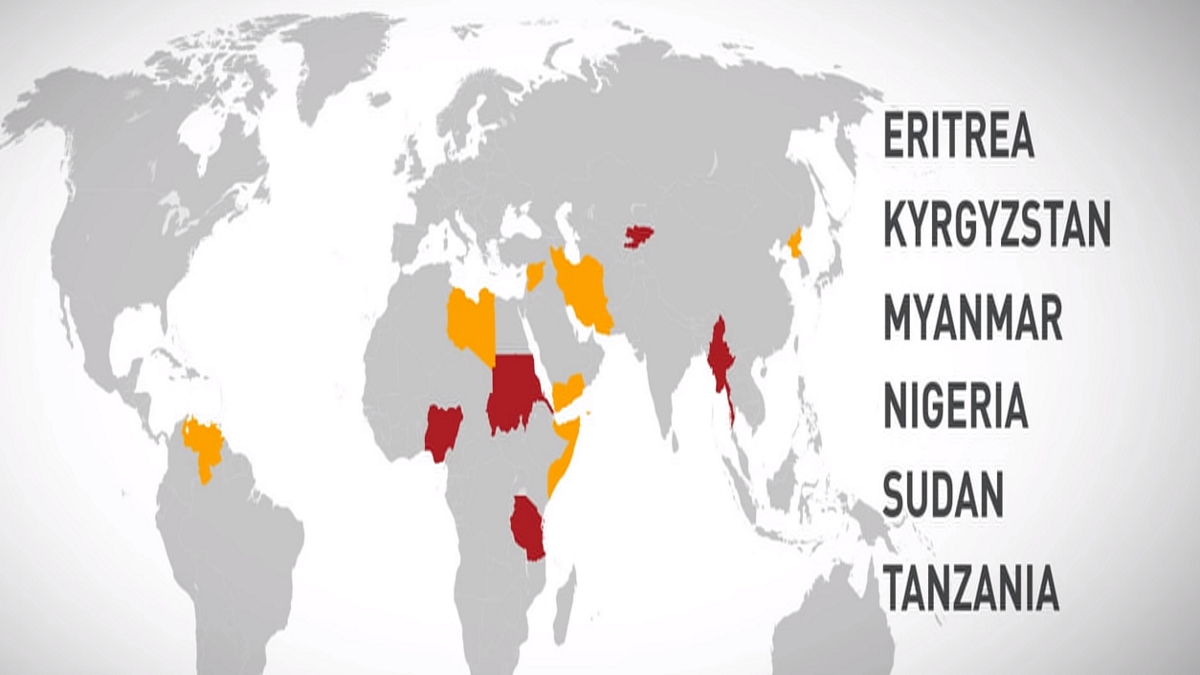
U.S. Department of Homeland Security (DHS) Acting Secretary Chad F. Wolf announced that President Donald J. Trump signed a proclamation, which places new, tailored visa restrictions on six countries that failed to meet a series of security criteria, demonstrating that they could be a risk to the homeland.


Burma, Eritrea, Kyrgyzstan, Nigeria, Sudan, Tanzania Will Face New Restrictions

Today, U.S. Department of Homeland Security (DHS) Acting Secretary Chad F. Wolf announced that President Donald J. Trump signed a proclamation, which places new, tailored visa restrictions on six countries that failed to meet a series of security criteria, demonstrating that they could be a risk to the homeland.

Acting Secretary Wolf also announced that the Department has updated the methodology it uses to assess compliance with the security criteria established under Executive Order 13780 in 2017.

This enhanced review process raises the bar for global security by requiring nations to meet the Department’s stronger security standards and by making it clear to countries what they must do to meet those standards. The updated criteria enhance our screening and vetting capabilities and allow DHS to better identify terrorists and criminals attempting to enter the United States.

“The top responsibility of the President and the Department of Homeland Security is the safety and security of the American people, and these new vetting criteria accomplish that goal and are raising the bar for global security,” said Acting Secretary Wolf. “It is logical and essential to thoroughly screen and vet everyone seeking to travel or immigrate to the United States.

Soffe Men’s 3 Pack-USA Poly Cotton Military Tee

However, there are some countries from which the U.S. does not receive the necessary information about its travelers and, as a result, pose a national security or public safety risk that warrants tailored travel restrictions.”

Wolf continued: “DHS has refined its robust security standards, including enhanced screening and vetting capabilities that allow us to better identify terrorists and criminals attempting to enter the United States. These screening and vetting capabilities are most effective when foreign governments contribute to our ability to verify a traveler’s identity and assess whether they pose a national security or public safety risk. For a small number of countries that lack either the will or the capability to adhere to these criteria, certain travel restrictions have become necessary to mitigate potential threats. The new, additional restrictions are not blanket restrictions. These tailored restrictions will make the U.S. safer and more secure. And countries that make the necessary improvements will have their restrictions removed accordingly, as was done in 2018.”

About the Refined Methodology

Pursuant to Executive Order 13780, DHS established identity-management, information sharing, national security, and public safety risk criteria all foreign governments are expected to adhere to in order to facilitate accurate and fair admissibility decisions under the Immigration and Nationality Act.

In its most recent review, DHS, in consultation with other departments and agencies, updated the methodology by which it reviews a foreign government’s performance. The update included refining and modifying specific performance metrics for each criteria, collecting additional data on foreign practices, and weighting criteria based on their degree of significance to U.S. national security. For example, DHS now considers whether a foreign government reports lost and stolen passports at least every 30 days, instead of considering whether they have ever shared such information. By reporting regularly, DHS officers can determine passport validity with higher confidence.

These changes give DHS a more detailed picture of a country’s compliance with the individual criteria and to hold them accountable for regular cooperation. In doing so, the updated methodology helps guide U.S. government discussions with foreign governments. Since implementing these measures, the Administration has recorded improvements in identity management and information sharing with multiple foreign governments, and because of this Administration’s actions, our international partners have raised their own baseline requirements.

About the New Restrictions

The Acting Secretary, in coordination with the Secretary of State, Attorney General, and Director of National Intelligence has conducted the fourth review required by Proclamation 9645. After further coordination with the other members of the cabinet and the National Security Council, the Acting Secretary submitted his recommendations to the President on September 13, 2019.

The travel restrictions imposed by the President today are tailored to the country-specific deficiencies identified during the review process and an assessment of travel-related risk. The new restrictions imposed by the President are less restrictive than the existing restrictions. Like the seven countries that continue to face travel restrictions pursuant to Proclamation 9645, the six additional countries added for restrictions are among the worst performing in the world; however, there are prospects for near-term improvement for these six countries. Each has a functioning government and each maintains productive relations with the United States. In each case and consistent with those restrictions imposed in 2017, the President has imposed specific travel restrictions to mitigate the risks posed. The restrictions imposed by this proclamation reflect the U.S. government’s greater confidence that these countries can make meaningful improvements in a reasonable period of time.

If that expectation is met, the President may remove travel restrictions at any time. Conversely, the President has also determined that if improvements are not made, additional restrictions may be added. Those travelers who have already been issued visas by the U.S. government will not be affected by the new restrictions.

Newly Imposed Restrictions

Burma: Burma has begun to engage with the United States on a variety of identity-management and information-sharing issues, but it does not comply with the established identity-management and information-sharing criteria assessed by the performance metrics.

Suspension of entry for Immigrants, except as Special Immigrants whose eligibility is based on having provided assistance to the U.S. Government.

Eritrea: Eritrea does not comply with the established identity-management and information-sharing criteria assessed by the performance metrics.

Suspension of entry for Immigrants, except as Special Immigrants whose eligibility is based on having provided assistance to the U.S. Government.

Kyrgyzstan: Kyrgyzstan does not comply with the established identity-management and information-sharing criteria assessed by the performance metrics.

Suspension of entry for Immigrants, except as Special Immigrants whose eligibility is based on having provided assistance to the U.S. Government.

Nigeria: Nigeria does not comply with the established identity-management and information-sharing criteria assessed by the performance metrics.

Suspension of entry for Immigrants, except as Special Immigrants whose eligibility is based on having provided assistance to the U.S. Government.

Sudan: Sudan generally does not comply with our identity management performance metrics and presents a high risk, relative to other countries in the world, of terrorist travel to the United States.

Suspension of entry for Diversity Immigrants, as described in section 203(c) of the INA, 8 U.S.C. 1153(c).

Tanzania: Tanzania does not comply with the established identity-management and information-sharing criteria assessed by the performance metrics.

Suspension of entry for Diversity Immigrants, as described in section 203(c) of the INA, 8 U.S.C. 1153(c).

The remarks as prepared can be found here: www.dhs.gov/news/2020/01/31/2020-travelvisa-restrictions

DHS.gov (February, 2020)  Raising the Global Travel Security Bar: DHS Announces New Travel Restrictions on Six Countries and Updated Process for Evaluating Foreign Country Compliance

Collegeville Man Indicted for Scheme to Sell Fraudulent Canine Cancer-Curing Drugs to Pet Owners

United States Attorney William M. McSwain announced that Jonathan Nyce, 70, of Collegeville, PA, was charged by Indictment with wire fraud and the interstate shipment of misbranded animal drugs.


The defendant promised to restore the health of terminally ill dogs and allegedly defrauded pet owners of hundreds of thousands of dollars

United States Attorney William M. McSwain announced that Jonathan Nyce, 70, of Collegeville, PA, was charged by Indictment with wire fraud and the interstate shipment of misbranded animal drugs. The charges arise from a years-long scheme to defraud pet owners of money by falsely claiming to sell canine cancer-curing drugs.

The Indictment alleges that the defendant created several companies beginning in 2012, including “Canine Care,” “ACGT,” and “CAGT,” through which he purported to develop drugs intended to treat cancer in dogs. Using various websites for these companies, the defendant marketed these “cancer-curing” medications to desperate pet owners, using the drug names “Tumexal” and “Naturasone.”

Soffe Men’s 3 Pack-USA Poly Cotton Military Tee

The websites made numerous allegedly false and fraudulent claims regarding the safety and efficacy of these supposed drugs, including that “Tumexal is effective against a wide variety of cancers,” and, “[i]n fact, Tumexal will almost always restore a cancer-stricken dog’s appetite, spirit and energy!” As alleged, these drugs were nothing more than a collection of bulk ingredients from various sources, which the defendant blended together himself at a facility on Arcola Road in Collegeville.

Further, through email and telephone conversations, Nyce allegedly induced the owners of terminally ill dogs to pay him hundreds or thousands of dollars for these drugs by touting the effectiveness of his products in treating a host of canine cancers. He also told prospective customers that their pets could become part of clinical trials, but in order to do so, they had to pay him large sums of money.

The defendant’s marketing, sale, and shipment of these drugs in interstate commerce is alleged to have violated the Food and Drug Administration’s Federal Food, Drug, and Cosmetic Act because the drugs were not approved by the FDA. The defendant even falsely claimed in promotional materials that his company’s research was “funded in part by the U.S. Food and Drug Administration.”

“The defendant’s alleged conduct here is shameful,” said U.S. Attorney McSwain. “As any dog owner will tell you – myself included – pets quickly become part of the family. And when they become sick, caring owners look for hope, often doing everything they can to keep their beloved pets alive and well. The defendant is charged with taking advantage of that nurturing instinct in the worst way possible by defrauding pet owners and giving them false hope that they might be able to save their dying pet. That is both cruel and illegal, and now the defendant will face the consequences.”

“American pet owners rely on the FDA to ensure their pets’ drugs are safe and effective,” said Special Agent in Charge Mark McCormack, FDA Office of Criminal Investigations’ Metro Washington Field Office.  “We will continue to investigate and bring to justice those who ignore or attempt to circumvent the law.”

If convicted, the defendant faces a maximum possible sentence of 32 years imprisonment and a fine of up to $1,250,000.

The case was investigated by the Food and Drug Administration’s Office of Criminal Investigation, and is being prosecuted by Assistant United States Attorney Christopher E. Parisi.

An indictment, information, or criminal complaint is an accusation. A defendant is presumed innocent unless and until proven guilty.

FDA.gov (February, 2020)  Collegeville Man Indicted for Scheme to Sell Fraudulent Canine Cancer-Curing Drugs to Pet Owners

 Help me maintain this news reporting blog by donating here.