Coast Guard Cutter Tampa returns home after interdicting $154 million in drugs.

The crew of the Coast Guard cutter Tampa returned to their home-port in Portsmouth, Virginia after an 80-day counter-drug patrol in the Eastern Pacific, Sunday.


PORTSMOUTH, Va. — The crew of the Coast Guard cutter Tampa returned to their home-port in Portsmouth, Virginia after an 80-day counter-drug patrol in the Eastern Pacific, Sunday.

The crew successfully executed the counter-narcotics mission, interdicting four vessels with a total of over 9,200 pounds of cocaine, worth an estimated $154 million dollars. The crew of the cutter also detained 12 suspected drug smugglers, boarded three additional vessels, and responded to one search and rescue case.

Shop Amazon Gift Cards. Any Occasion. No Expiration.

The cutter began the patrol by embarking an armed helicopter crew from the Coast Guard’s Helicopter Interdiction Tactical Squadron (HITRON) in Mayport, Florida. Working together they were able to increase the Coast Guard’s ability to detect and stop vessels suspected of drug smuggling.

Prior to entering the primary patrol area, the crew of the Tampa conducted a training engagement with the Guatemalan Navy in Puerto Santo Tomás de Castilla as part of Operation Crested Eagle. The crew of the Tampa provided law enforcement training, tours of the ship, and engineering technical support for Guatemalan naval vessels.

The crew is looking forward to spending time with friends and family during a well-deserved stand-down period. They will then prepare for the biennial Tailored Ship’s Training Availability, a several week program designed to train the crew and assess the readiness of the cutter through a variety of drills.

Soffe Men’s 3 Pack-USA Poly Cotton Military Tee

“I am humbled and very proud of what our crew has accomplished during this patrol,” said Cmdr. Michael Cilenti, commanding officer of the Tampa. “Just keeping our 36-year old ship operating is a full time job, and our crew not only did that, but safely and professionally executed our counter-drug mission. Saving lives by keeping drugs off our streets and helping eliminate drug cartels’ destabilizing influence of our Central and South American neighbors is something we all care very deeply about. We are looking forward to getting home to see our loved ones; we would not be able to achieve the success we did without the tremendous support of our family and friends, for which we are all deeply appreciative.”

USCG.mil (February, 2020) Coast Guard Cutter Tampa returns home after interdicting $154 million in drugs.

Baltimore CBP Repatriates Priceless Artifacts to Cyprus Government Officials

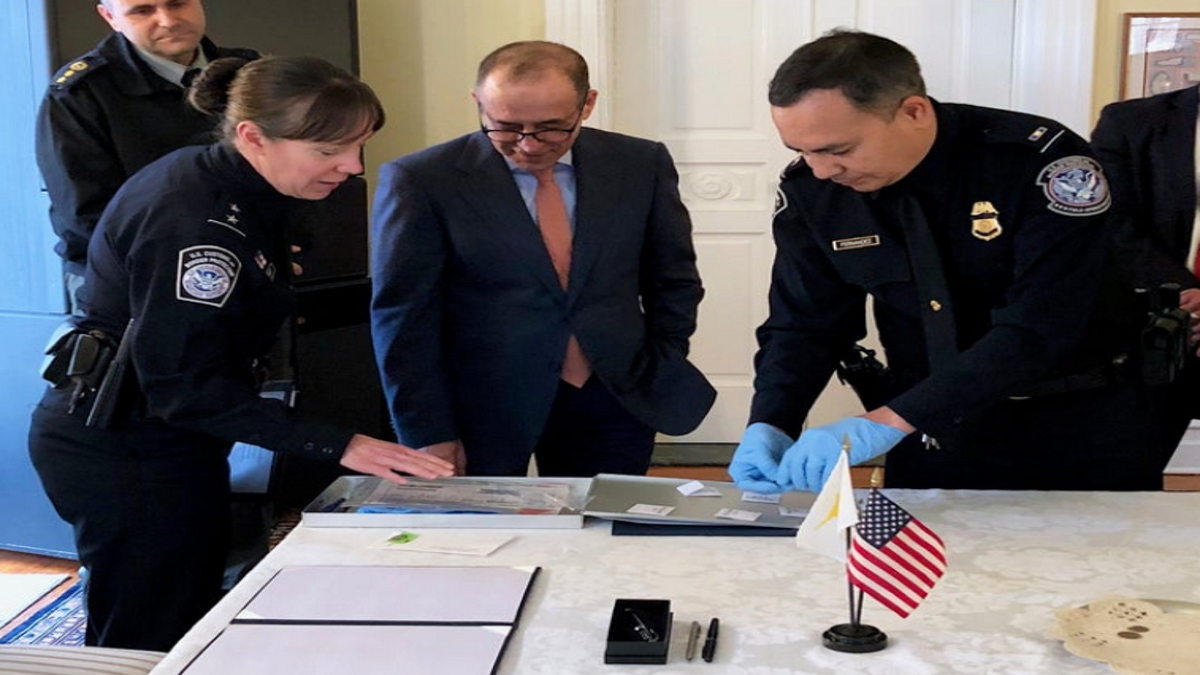
U.S. Customs and Border Protection’s (CBP) Baltimore Field Office repatriated seven ancient coins, dating back to 81 BC, to the Embassy of Cyprus today that Baltimore CBP officers initially discovered in an air cargo shipment in April 2009.


Officers detained the antiquities, which dated to 400 BC, in 2009

U.S. Customs and Border Protection’s (CBP) Baltimore Field Office repatriated seven ancient coins, dating back to 81 BC, to the Embassy of Cyprus today that Baltimore CBP officers initially discovered in an air cargo shipment in April 2009.

An appraisal determined that the collection dated from the Roman Empire, from several periods during 81 BC through 217 AD. The collection includes:

  • Two bronze coins from an unspecified Roman period
  • One coin from the Ptolemaeus period, 81 BC -58 BC
  • One coin from the Augustus period, 27 BC – 14 AD
  • Two coins from the Tiberius period, 14-37 AD
  • One coin from the Severan period, 193 AD – 217 AD

“On behalf of U.S. Customs and Border Protection, I am honored to return these priceless national treasures to the government and citizens of Cyprus,” said Casey Durst, CBP’s Director of Field Operations in Baltimore. “Customs and Border Protection will continue to use our border authority to identify and rescue precious antiquities being smuggled by those who profit on the theft of another country’s historical and cultural property, and return them to their rightful owners.”

CBP officers from the Area Port of Baltimore initially encountered the ancient coins in April 2009 during an inspection of air cargo that arrived from London. This specific parcel was destined to a coin collector in Missouri.

CBP issued a letter to the consignee requesting any documentation they received from the government of Cyprus authorizing the lawful importation of these cultural artifacts.

Most countries have laws that protect their cultural property, such as art, artifacts, antiquities, or other archeological and ethnological material. These laws include export controls and national ownership of cultural property. Therefore, although they do not necessarily confer ownership, consignees or importers must have documents such as export permits and receipts when importing such items into the United States.

Soffe Men’s 3 Pack-USA Poly Cotton Military Tee

In May 2009, the consignee admitted to not possessing authority from the government of Cyprus to import the artifacts, and CBP officers seized the coins.

Additionally, the parcel contained Chinese coins determined to be from the Zhou, Han and Western Han dynasties, dating from 400 BC through 220 AD.

CBP contracted an appraiser to determine the estimated ages of the artifacts.

The coin collector lost a protracted legal challenge to regain possession of the coins and CBP’s Office of International Affairs coordinated with the government of Cyprus to repatriate the coins during a ceremony today at their Embassy in Washington, D.C.

The Department of Homeland Security enforces the cultural property import restrictions agreed to in bilateral agreements that the United States has concluded with 20 countries and through emergency import restrictions for three additional countries. These bilateral agreements protect cultural property by restricting U.S. import of certain categories of archeological and ethnological material, thus reducing incentive for looting at heritage sites. Read more about these bilateral agreements on importation of cultural property.

CBP recorded 23 seizures of cultural property during 2019 with a domestic value of nearly $1 million. CBP partners with Immigration and Customs Enforcement in the detection, interception, investigation and repatriation of cultural property. Read more about ICE Cultural Property investigations.

CBP officers screen international travelers and cargo and search for illicit narcotics, unreported currency, weapons, counterfeit consumer goods, prohibited agriculture, and other illicit products that could potentially harm the American public, U.S. businesses, and our nation’s safety and economic vitality. Learn about what CBP accomplished during “A Typical Day” in 2019.

CBP.gov (February, 2020) Baltimore CBP Repatriates Priceless Artifacts to Cyprus Government Officials U.S. Customs and Border Protection’s Director of Baltimore Field Operations Casey Durst (left) presented seven ancient coins to Cyprus Ambassador Marios Lyssiotis Friday during a repatriation ceremony at the Cyprus Embassy in Washington, D.C. (Photo courtesy of CBP.)

Government Contractor Sentenced to 57 Months in Prison for $3.7 Million Procurement Fraud Scheme

A former government contractor was sentenced to 57 months in prison for his role in carrying out a $3.7 million scheme to defraud at least 35 subcontractors located across the United States.


A former government contractor was sentenced to 57 months in prison for his role in carrying out a $3.7 million scheme to defraud at least 35 subcontractors located across the United States.

Chester L. Neal Jr., 45, of Bourbon Oak, Missouri, was sentenced by U.S. District Judge Dale A. Drozd of the Eastern District of California.  Judge Drozd also ordered Neal to pay restitution in the amount of $3,734,927.50.

Neal pleaded guilty on Aug. 19, 2019, to one count of mail fraud.  According to admissions made in connection with his plea, Neal established and controlled several companies through which he bid on and won at least 105 government contracts to provide goods and services to federal agencies including the Department of Interior, U.S. Army and U.S. Air Force. 

Soffe Men’s 3 Pack-USA Poly Cotton Military Tee

The contracts required Neal to purchase and transport rock, gravel, and other raw materials to military bases and national parks. After winning these contracts, Neal fraudulently induced subcontractors to perform the required work. 

But when Neal was paid by the government for his subcontractors’ work, he did not pay his subcontractors. Instead, Neal kept the money and spent it at places like casinos, nightclubs, restaurants and hotels. 

In total, between July 2008 and December 2017, Neal defrauded his subcontractors out of approximately $3.7 million.

Assistant Attorney General Brian A. Benczkowski of the Justice Department’s Criminal Division, U.S. Attorney McGregor W. Scott of the Eastern District of California, Special Agent in Charge David A. House of the Department of Interior Office of Inspector General’s (DOI-OIG) Western Region Office of Investigations, Special Agent in Charge Ray Park of the U.S. Army Criminal Investigation Command’s (Army CID) Major Procurement Fraud Unit, Pacific Fraud Field Office, Special Agent in Charge Sean Ragan of the FBI’s Sacramento Division, Special Agent in Charge Jason Hein of the Air Force Office of Special Investigations’ (Air Force OSI) Office of Procurement Fraud Unit, and Special Agent in Charge Brian Denny of the Defense Criminal Investigative Service’s (DCIS) Western Field Office made the announcement.

Cell Phones and Accessories

DOI-OIG, Army CID, the FBI, Air Force OSI and DCIS investigated this matter.

Trial Attorney Kyle W. Maurer of the Criminal Division’s Fraud Section and Assistant U.S. Attorney Grant B. Rabenn of the Eastern District of California prosecuted the case.

DODIG.mil; Justice.gov (February, 2020) Government Contractor Sentenced to 57 Months in Prison for $3.7 Million Procurement Fraud Scheme

2019 Internet Crime Report Released

Internet-enabled crimes and scams show no signs of letting up, according to data released by the FBI’s Internet Crime Complaint Center (IC3) in its 2019 Internet Crime Report.


Data Reflects an Evolving Threat and the Importance of Reporting

Internet-enabled crimes and scams show no signs of letting up, according to data released by the FBI’s Internet Crime Complaint Center (IC3) in its 2019 Internet Crime Report. The last calendar year saw both the highest number of complaints and the highest dollar losses reported since the center was established in May 2000.

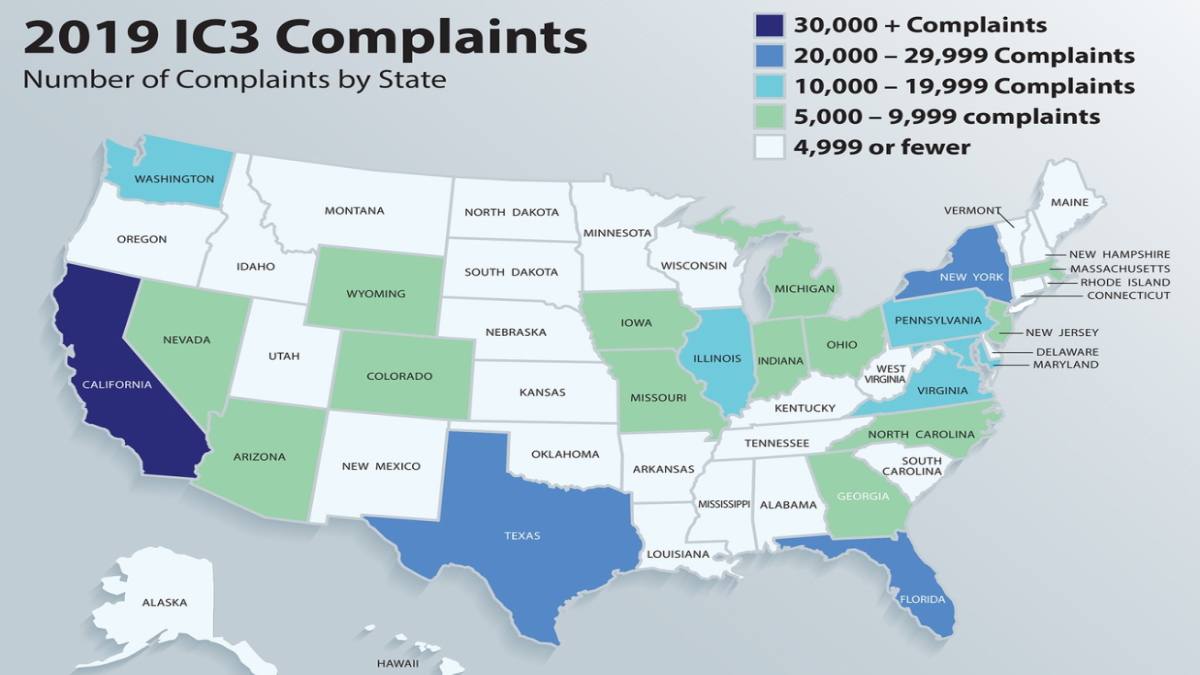
IC3 received 467,361 complaints in 2019—an average of nearly 1,300 every day—and recorded more than $3.5 billion in losses to individual and business victims. The most frequently reported complaints were phishing and similar ploys, non-payment/non-delivery scams, and extortion. The most financially costly complaints involved business email compromiseromance or confidence fraud, and spoofing, or mimicking the account of a person or vendor known to the victim to gather personal or financial information.

Donna Gregory, the chief of IC3, said that in 2019 the center didn’t see an uptick in new types of fraud but rather saw criminals deploying new tactics and techniques to carry out existing scams.

“Criminals are getting so sophisticated,” Gregory said. “It is getting harder and harder for victims to spot the red flags and tell real from fake.”

Soffe Men’s 3 Pack-USA Poly Cotton Military Tee

While email is still a common entry point, frauds are also beginning on text messages—a crime called smishing—or even fake websites—a tactic called pharming.

“You may get a text message that appears to be your bank asking you to verify information on your account,” said Gregory. “Or you may even search a service online and inadvertently end up on a fraudulent site that gathers your bank or credit card information.”

Individuals need to be extremely skeptical and double check everything, Gregory emphasized. “In the same way your bank and online accounts have started to require two-factor authentication—apply that to your life,” she said. “Verify requests in person or by phone, double check web and email addresses, and don’t follow the links provided in any messages.”

Shifts in Business Email Compromise

Business email compromise (BEC), or email account compromise, has been a major concern for years. In 2019, IC3 recorded 23,775 complaints about BEC, which resulted in more than $1.7 billion in losses.

These scams typically involve a criminal spoofing or mimicking a legitimate email address. For example, an individual will receive a message that appears to be from an executive within their company or a business with which an individual has a relationship. The email will request a payment, wire transfer, or gift card purchase that seems legitimate but actually funnels money directly to a criminal.

In the last year, IC3 reported seeing an increase in the number of BEC complaints related to the diversion of payroll funds. “In this type of scheme, a company’s human resources or payroll department receives an email appearing to be from an employee requesting to update their direct deposit information for the current pay period,” the report said. The change instead routes an employee’s paycheck to a criminal.

The Importance of Reporting

“Information reported to the IC3 plays a vital role in the FBI’s ability to understand our cyber adversaries and their motives, which, in turn, helps us to impose risks and consequences on those who break our laws and threaten our national security,” said Matt Gorham, assistant director of the FBI’s Cyber Division. “It is through these efforts we hope to build a safer and more secure cyber landscape.” Gorham encourages everyone to use IC3 and reach out to their local field office to report malicious activity. 

Rapid reporting can help law enforcement stop fraudulent transactions before a victim loses the money for good. The FBI’s Recovery Asset Team was created to streamline communication with financial institutions and FBI field offices and is continuing to build on its success. The team successfully recovered more than $300 million for victims in 2019.

Besides stressing vigilance on the part of every connected citizen, the IC3’s Donna Gregory also stressed the importance of victims providing as much information as possible when they come to IC3. Victims should include every piece of information they have—any email addresses, account information they were given, phone numbers scammers called from, and other details. The more information IC3 can gather, the more it helps combat the criminals.

In 2019, the Recovery Asset Team was paired with the Money Mule Team under the IC3’s Recovery and Investigative Development Team. This effort brings together law enforcement and financial institutions to use the data provided in IC3 complaints to gain a better view of the networks and methods of cyber fraudsters and identify the perpetrators.

The new effort allowed IC3 to aggregate more than three years of reports to help build a case against an active group of criminals who were responsible for damaging crimes that ranged from cryptocurrency theft to online extortion. The ensuing investigation by the FBI’s San Francisco Field Office resulted in the arrest of three people.

Read the full 2019 Internet Crime Report.

To stay up to date on common online scams and frauds or report a crime, visit ic3.gov.

FBI.gov (February, 2020) 2019 Internet Crime Report Released

SchoolSafety.gov Launches to Help Educators, Administrators, Parents, and Law Enforcement Prepare for Threats

The Trump Administration on Monday launched the Federal School Safety Clearinghouse website: SchoolSafety.gov.


DHS, ED, DOJ, HHS team up to provide government-wide resources for local schools and educators

The Trump Administration on Monday launched the Federal School Safety Clearinghouse website: SchoolSafety.gov.

This website is a one-stop-shop of resources for Kindergarten through Grade 12 (K-12) administrators, educators, parents and law enforcement to use to prepare for and address various threats related to safety, security, and support in schools.

President Trump established the Federal Commission on School Safety to review safety practices and make meaningful and actionable recommendations of best practices to keep students safe.

“School safety is the number one priority of parents across the country, which is why the President directed DHS and other federal agencies to form a taskforce and provide schools, teachers, parents, and law enforcement with resources to identify, prepare for, respond to, and mitigate threats, “said Chad Wolf, Acting Secretary of the Department of Homeland Security. “The Department provided expertise and resources on a range of school safety issues including threat assessments, physical security, emergency planning, and trainings and exercises designed to help schools and local law enforcement prepare for incidents. With these resources, schools and law enforcement will be better equipped to handle a crisis.”

“All students deserve a safe learning environment, and the Federal School Safety Clearinghouse is an essential resource for information and best practices,” said U.S. Secretary of Education Betsy DeVos, chair of the Federal Commission on School Safety. “Because every school community has its own unique needs, SchoolSafety.gov equips decision makers with resources for developing, customizing, and implementing actionable school safety plans.”

Soffe Men’s 3 Pack-USA Poly Cotton Military Tee

“Every child should feel safe at school, and every parent should feel their child is safe each day, too,” said HHS Secretary Alex Azar. “SchoolSafety.gov will help equip schools with the tools they need to create safe, healthy environments, including resources for how to provide mental health services in schools. This new one-stop shop complements the evidence-based technical assistance HHS provides to local communities around mental health treatment, and we hope to see more and more schools explore these opportunities.”

“The Department of Justice has no higher priority than making sure our schools are safe and secure for our nation’s students, teachers and administrators,” said Attorney General William P. Barr. “I am grateful for President Trump’s leadership in this cause and am honored to stand with the rest of the leadership of his Administration as we continue our efforts to promote school safety through schoolsafety.gov. The Department of Justice is deeply grateful for the sacrifice and commitment of our nation’s school resource officers and police officers who are on the front lines of keeping our schools and country safe every day.”

SchoolSafety.gov is a resource for the American public, primarily K-12 school administrators, to access free information, guidance, best practices, and tools that make school safety initiatives more actionable in schools. Today’s launch represents the first phase of SchoolSafety.gov and we look forward to continually expanding and refining resource materials in coordination with our partners and stakeholders.

The Federal School Safety Clearinghouse and SchoolSafety.gov were developed to fulfill one of the key recommendations from the Federal Commission on School Safety.

SchoolSafety.gov includes:

  • The School Safety Readiness Tool, an assessment that assists users in evaluating their respective school’s safety posture across ten foundational elements of school safety. After completing the assessment, users are provided an action plan with task prioritization, options for consideration, aligned resources, and grant opportunities specific to individual needs;
  • A Secure Information Sharing Platform for designated school personnel to share school safety ideas, practices, plans, and tactics in a protected environment; and
  • A wide array of resources and best practices on key school safety topics to assist with building awareness within the school community to promote vigilance and build capacity to respond to incidents.

SchoolSafety.gov empowers districts and schools to improve safety and security. Following the school shooting in Parkland, Florida in March 2018, President Trump established the Federal Commission on School Safety by Executive Order to make meaningful advancements in keeping students safe.

The Trump Administration and DHS also released the 2019 strategy for targeted violence that defines ways that the Department will enhance security with increased preparedness, promoting community readiness, and enhancing defensive measures. The Department will continue to develop new techniques in protective practices.

DHS.gov (February, 2020) SchoolSafety.gov Launches to Help Educators, Administrators, Parents, and Law Enforcement Prepare for Threats