Operator of durable medical equipment company charged in multi-million-dollar telemedicine kickback scheme


Defendant is the 22nd charged in largest fraud scheme ever prosecuted by Southern District of Georgia

A California man who operated a durable medical equipment (DME) company has been charged for his alleged participation in a massive healthcare fraud scheme.

The defendant is the 22nd charged in the Southern District of Georgia as part of an investigation that uncovered more than $410 million in fraudulent claims to Medicare, the largest fraud case in the history of the Southern District of Georgia.

Scott M. Hirsch, the operator of JI Medical, Inc., a California company, is accused of conspiring to pay kickbacks in exchange for obtaining orders for DME that JI Medical, Inc. would then bill to Medicare. Those Medicare beneficiaries were located in the Southern District of Georgia and elsewhere. As part of this scheme, the physicians receiving the kickbacks from JI Medical, Inc. knowingly signed false medical records describing “consultations” of Medicare patients. The operator of JI Medical, Inc. was charged by way of an Information, filed in the U.S. District Court for the Southern District of Georgia.

“Telemedicine is an important tool for legitimate providers – but paying kickbacks is not part of telemedicine and will not be tolerated under any circumstances,” said U.S. Attorney Bobby L. Christine. “While many of our prosecutors and law enforcement partners may be working remotely during the COVID-19 pandemic, this office continues to work day and night to bring bad actors to justice.” 

The healthcare fraud scheme charged is the largest in the history of the Southern District of Georgia. Previous charges in this string of cases include eight physicians, two nurse practitioners, two operators of telemedicine companies, and two brokers of patient data. The Medicare and Medicaid beneficiaries whose identities were used as part of the scheme are located throughout the Southern District of Georgia, including the Augusta, Brunswick, Dublin, Savannah, Statesboro, and Waycross Divisions, as well as elsewhere in the United States.

The $410 million fraud scheme charged in the Southern District of Georgia is part of nationwide operations by the Department of Justice that thus far has halted a multi-billion dollar fraud network involving fraudulent claims for genetic testing, orthotic braces, pain creams, and other items.

“The growing number of medical providers and equipment providers alleged to have been involved in this ongoing scheme is disheartening,” said Chris Hacker, Special Agent in Charge of FBI Atlanta. “The FBI and our federal partners will continue to root out such deceitful practices and protect taxpayers and the citizens who deserve the benefits from programs like Medicare, even as telemedicine becomes more common.” 

 “This investigation is a stellar example of inter-agency cooperation and working together to bring those who defraud the health care system to justice,” said FBI Birmingham Special Agent in Charge Johnnie Sharp Jr. “The public can be assured that the FBI and our partners will continue to seek to identify and pursue investigations against such egregious offenders.”

“In these trying times, it’s more important than ever that we safeguard the Medicare trust fund,” said Derrick L. Jackson, Special Agent in Charge at the U.S. Department of Health and Human Services, Office of Inspector General in Atlanta. “HHS/OIG, along with our partners, will vigorously pursue any provider who puts their own financial gain above that of their patients.”

“Cases of this magnitude can only be tackled using a strategy that recognizes that the most effective way to fight these large criminal networks is by combining the strengths, resources, and expertise of our federal agencies,” said Resident Agent in Charge Glen M. Kessler of the U.S. Secret Service. “Our nation’s healthcare system cannot tolerate kickbacks to physicians and pharmacies while criminals line their pockets with taxpayer funded healthcare dollars.”

“The U.S. Postal Inspection Service aggressively conducts investigations of those who fraudulently use the U.S. Mail to facilitate complex fraud schemes,” said Inspector in Charge Joseph W. Cronin of the U.S. Postal Inspection Service’s Boston Division.  “We will continue to support and work with our federal law enforcement partners to stop those who are engaged in these types of fraudulent activities and defend the U.S. Mail from criminal misuse.”

“The defendant in this case used the U.S. Mail to facilitate his elaborate criminal scheme. Postal Inspectors partnered with other agencies to quickly identify the scheme and worked aggressively with the U.S. Attorney’s Office to dismantle this criminal enterprise. Through cases like these, the Postal Inspection Service upholds its longstanding mission of protecting the public and preventing criminal misuse of the U.S. Mail,” said Antonio J. Gomez, Inspector in Charge of the U.S. Postal Inspection Service – Miami Division.

Indictments or criminal information contain only charges; defendants are presumed innocent unless and until proven guilty.

This investigation is ongoing. As telemedicine becomes an increasing part of our healthcare system, vigilance in ensuring that fraud and kickbacks do not usurp the legitimate practice of medicine by electronic means is more important than ever. If you are aware of any fraud or kickbacks relating to telemedicine, including COVID-19 fraud, please call the FBI hotline at 1-800-CALL-FBI.

This particular prosecution resulted from a joint investigation of multiple agencies and offices.  U.S. Attorney Christine acclaimed the hard work of the investigatory team, led by FBI – Savannah, FBI – Birmingham, the Department of Health and Human Services Office of Inspector General, the United States Secret Service, and the United States Postal Inspection Service.

Assistant U.S. Attorneys J. Thomas Clarkson and Jonathan A. Porter are prosecuting these cases on behalf of the United States.

Justice.gov (April 2020) Operator of durable medical equipment company charged in multi-million-dollar telemedicine kickback scheme
International COVID-19 fraud exposed

A sophisticated fraud scheme using compromised emails, advance-payment fraud and money laundering has been uncovered by financial institutions and authorities across Germany, Ireland and the Netherlands


INTERPOL-coordinated case leads to arrests and sparks investigations around Europe

A sophisticated fraud scheme using compromised emails, advance-payment fraud and money laundering has been uncovered by financial institutions and authorities across Germany, Ireland and the Netherlands, as part of a case coordinated by INTERPOL.

In mid-March, as a number of countries were going into lock-down due to the coronavirus outbreak, German health authorities contracted two sales companies in Zurich and Hamburg to procure EUR 15 million worth of face masks. With a global shortage on medical supplies complicating usual business channels, the buyers followed new leads in the hopes of securing the masks.

It all started with an email address and website which appeared to be linked to a legitimate company in Spain selling face masks. Unbeknownst to the buyers, the site was a fake and their legitimate email addresses had been compromised.

Through email correspondence, the company initially claimed to have 10 million masks, only for the delivery to fall through. As consolation, they then referred the buyers to a ‘trusted’ dealer in Ireland. The Irish middleman promised to put them in touch with a different supplier, this time in the Netherlands.

Claiming to have a strong commercial relationship with the company, the man provided assurances that the alleged Dutch company would be able to supply the 10 million face masks. An agreement for an initial delivery of 1.5 million masks was made, in exchange for an up-front payment of EUR 1.5 million.

The buyers initiated a bank transfer to Ireland and prepared for delivery, which involved 52 lorries and a police escort to transport the masks from a warehouse in the Netherlands to the final destination in Germany.

Just before the delivery date, the buyers were informed that the funds had not been received and that an emergency transfer of EUR 880,000 straight to the Dutch supplier was required to secure the merchandise.

When the buyers realized they had been duped, they immediately contacted their bank in Germany, which in turn contacted INTERPOL’s Financial Crimes unit, setting off a race to intercept the funds and follow the money trail.

Banks, financial intelligence units and judicial authorities, as well as partner organizations Europol and EUROJUST, joined INTERPOL in the chase.

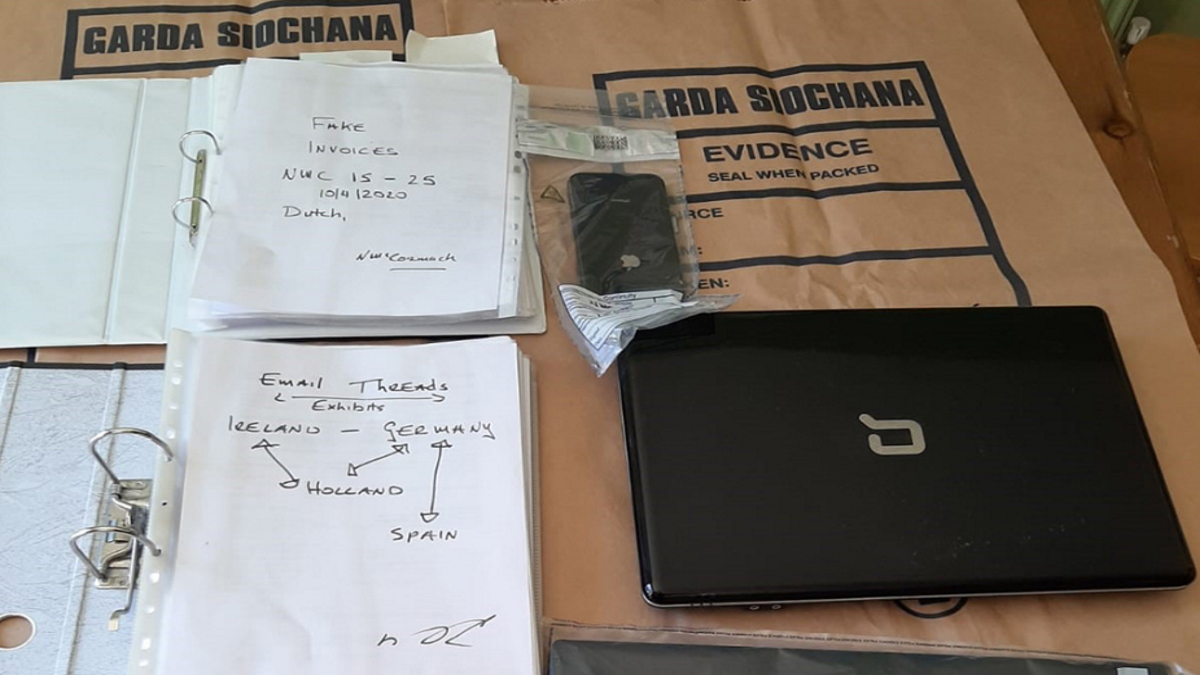
INTERPOL contacted its National Central Bureau in Dublin as well as the Irish bank. Prompt intervention by the Garda National Economic Crime Bureau allowed them to freeze the 1.5 million in the account and identify the Irish company involved.

The Dutch Fiscal Information and Investigation Service quickly tracked down the EUR 880,000 which had been transferred from the German company. Nearly EUR 500,000 of those funds had already been sent to the United Kingdom, all of which was destined for an account in Nigeria.

Europol activated its professional networks to reach key contacts in the banking sector. Thanks to an alert raised by investigators, the UK bank was able to recall the full amount. Those funds have now been returned to the Netherlands and frozen by authorities.

“They adapted their sales pitches to take advantage of strained supply chains and generate huge profits. I can only salute the quick work of both the private and public authorities involved. INTERPOL will continue its work on the case – and the many others like it – in close cooperation with all of our partners,” added the INTERPOL Chief.

The operation has already led to the arrest of two suspects in the Netherlands. More arrests are likely as specialized units continue to liaise closely with INTERPOL, as well as the public prosecutor and police forces in Traunstein (Germany) on leads generated by seized devices.

INTERPOL would like to remind members of the public to be vigilant as organized crime groups continue to adapt their activities to benefit from the global health crisis.

Interpol.int (April 2020) Unmasked: International COVID-19 fraud exposed

US Issues an Advisory on North Korean Cyber Threats

On Wednesday, April 15, the U.S. Departments of State, Homeland Security, and Treasury, and the Federal Bureau of Investigation issued an advisory to raise the awareness of the cyber threat posed by North Korea.


On Wednesday, April 15, the U.S. Departments of State, Homeland Security, and Treasury, and the Federal Bureau of Investigation issued an advisory to raise the awareness of the cyber threat posed by North Korea. 

The advisory highlights North Korea’s malicious cyber activities around the world, identifies U.S. government resources that provide technical and threat information, and includes recommended measures to counter the cyber threat.

North Korea’s malicious cyber activities threaten the United States and countries around the world and, in particular, pose a significant threat to the integrity and stability of the international financial system.  The United States works closely with like-minded countries to focus attention on and condemn disruptive, destructive, or otherwise destabilizing behavior in cyberspace.  

It is vital for foreign governments, network defenders, and the public to stay vigilant and to work together to mitigate the cyber threat posed by North Korea.

The DPRK’s malicious cyber activities threaten the United States and the broader international community and, in particular, pose a significant threat to the integrity and stability of the international financial system. Under the pressure of robust U.S. and UN sanctions, the DPRK has increasingly relied on illicit activities – including cybercrime – to generate revenue for its weapons of mass destruction and ballistic missile programs.

In particular, the United States is deeply concerned about North Korea’s malicious cyber activities, which the U.S. government refers to as HIDDEN COBRA. The DPRK has the capability to conduct disruptive or destructive cyber activities affecting U.S. critical infrastructure. The DPRK also uses cyber capabilities to steal from financial institutions, and has demonstrated a pattern of disruptive and harmful cyber activity that is wholly inconsistent with the growing international consensus on what constitutes responsible State behavior in cyberspace. 

The United States works closely with like-minded countries to focus attention on and condemn the DPRK’s disruptive, destructive, or otherwise destabilizing behavior in cyberspace. For example, in December 2017, Australia, Canada, New Zealand, the United States, and the United Kingdom publicly attributed the WannaCry 2.0 ransomware attack to the DPRK and denounced the DPRK’s harmful and irresponsible cyber activity. Denmark and Japan issued supporting statements for the joint denunciation of the destructive WannaCry 2.0 ransomware attack, which affected hundreds of thousands of computers around the world in May 2017. 

It is vital for the international community, network defenders, and the public to stay vigilant and to work together to mitigate the cyber threat posed by North Korea. 

The North Korean Cyber Threat Advisory can be viewed at: https://www.us-cert.gov/ncas/alerts/aa20-106a.

State.gov (April 2020) The United States Issues an Advisory on North Korean Cyber Threats

BBB Warns About Sharing Your Senior Photo on Facebook, other Social Media


On Monday, the Better Business Bureau (BBB) cautions everyone on social media to be aware of what they are sharing, even if you think it’s just going to your friends, it could also be going somewhere else.

It seems harmless and fun! A bunch of friends on Facebook or other social media are sharing their senior portraits, including the high school name and graduation year, to support the graduating class of 2020 (most of whom are at home because of the coronavirus pandemic). 

Watch out, scammers or hackers who surf through social media sites will see these #ClassOf2020 posts, and will now have the name of your high school and graduation year, which are common online security questions.

All it takes is an internet search to reveal more information about you, such as family members, your real name, and birth date or even where you live.

Other recent viral personal list posts include all the cars you’ve owned (including makes/model years), favorite athletes, and top 10 favorite television shows.

What most people forget is that some of these “favorite things” are commonly used passwords or security questions. If your social media privacy settings aren’t high, you could be giving valuable information away for anyone to use.

BBB has the following tips to keep you safe on social media:

Resist the temptation to play along. While it’s fun to see other’s posts, if you are uncomfortable participating, it is best to not do it.

Review your security settings. Check your security settings on all social media platforms to see what you are sharing and with whom you are sharing.

Change security questions/settings. If you are nervous about something you shared possibly opening you up to fraud, review and change your security settings for banking and other websites. 

For more information about privacy concerns online, see BBB’s scam alert on Facebook quizzes.

For tips for staying safe online, read BBB’s tips on staying cybersecure.

Report scams to BBB Scam Tracker.

BBB.org (April 2020) BBB Tip: Thinking of sharing your senior photo on Facebook? Think twice!

Chinese Pastor Charged with Subversion of State Power


House Church Pastor Arrested for Refusing to Join State-Vetted Church

International Christian Concern (ICC) has learned that a house church pastor in China’s Hunan province was arrested on April 2, after being criminally detained since March 14 for “inciting subversion of state power.”

On April 11, Bethel Church sent out an urgent prayer request for its pastor, Zhao Huaiguo, asking for nationwide prayers for its pastor who was arrested on April 2 on subversion charges.

Automotive Best Sellers

Zhao, the founder of Bethel Church in Cili county, has served at his church for 13 years, cultivating many leaders among the several hundred members. The church refused to join the state-vetted Three-Self church and was banned last year by the government.

According to China Aid, a local Christian shared that the authorities have been hostile toward Pastor Zhao since his church refused to join the state-sanctioned church and rejected government officials’ intervention. “He was accused of proselytizing and distributing Gospel tracts, which were considered illegal acts. After Lunar New Year last year, the religious bureau forced the church to disperse, to which it refused. The official ban arrived last April,” said the local Christian.

On April 10, 2019, nearly 50 people from the local authorities raided Bethel Church, damaging church property and confiscating Bibles, a piano, and hymn books. Pastor Zhao and other members were questioned and warned.

A Bethel Church member told China Aid that from March to December 2019, the public security police have repeatedly harassed the church, taking its preachers in for investigation and forcing them to sign an agreement that they would not preach or hold any more religious activities.

Following Zhao’s arrest, the authorities have been investigating the church’s offering and its sources, in an effort to find proof to accuse Pastor Zhao. Yet, since the church members refused to provide information, the police have made little progress thus far.

Gina Goh, ICC’s Regional Manager for Southeast Asia, said“For the Chinese Communist Party (CCP) to slap the charge of ‘inciting subversion of state power’ on Pastor Zhao, typically used against human rights lawyers and activists, it shows how the regime is fearful of anybody who is disobedient to the CCP. The laws in China now have become tools for the government to silence and weaken its citizens’ influence, even in a religious setting. The lack of rule of law in China should gravely concern the international community.”

Persecution.org (April 2020) Chinese Pastor Charged with Subversion of State Power