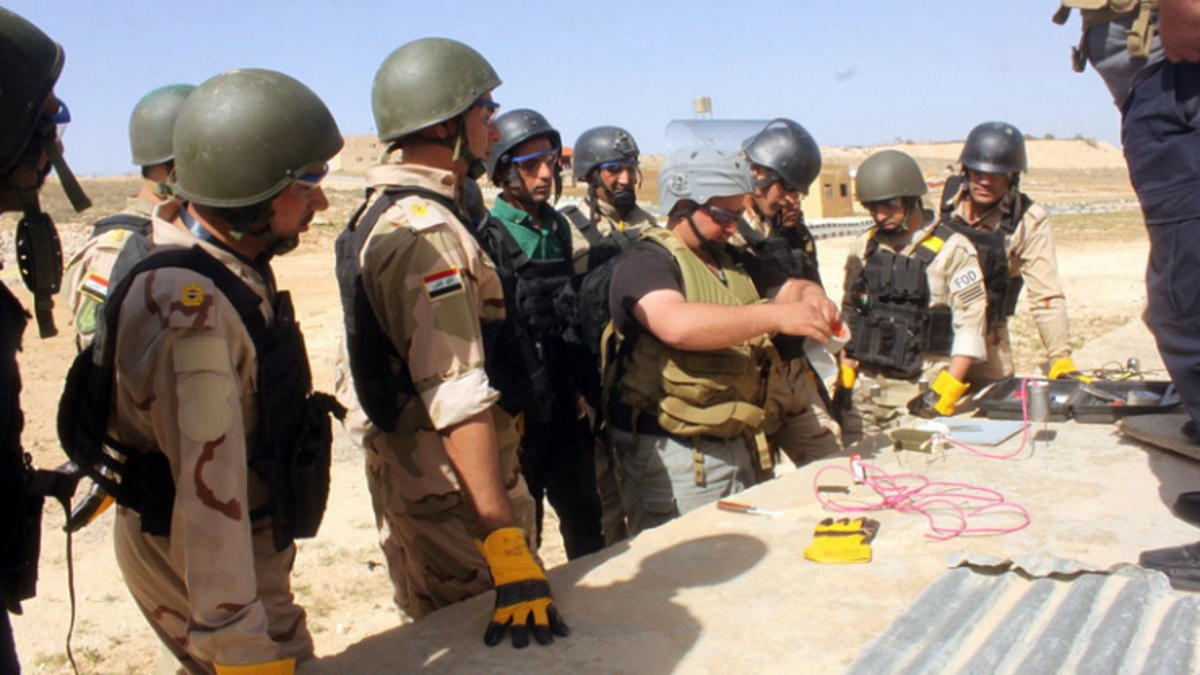
Iran Poses Greatest Threat to Region, Centcom Commander Says

Iran poses the greatest threat to regional security and stability, the commander of U.S. Central Command said.


Iran poses the greatest threat to regional security and stability, the commander of U.S. Central Command said.

Marine Corps Gen. Kenneth F. McKenzie Jr. spoke last week at a Middle East Institute webinar titled, “Centcom and the Shifting Sands of the Middle East.”

McKenzie enumerated various threats from Iran:

  • Funding and arming terrorist organizations;
  • Propping up the “murderous regime” of Syrian President Bashar al-Assad;
  • Providing advanced weapons to the Houthi rebels in Yemen;
  • Direct attack on oil tankers in the Strait of Hormuz;
  • Direct attack on oil refineries in Saudi Arabia; and 
  • Attacking U.S. troops in Iraq. 

“Iran actively stokes instability and is intent on degrading security all over the region,” McKenzie said. “They use proxies and violence to push other nations in the region to their agenda.”

The State Department is leading the effort to pressure Iranian leaders diplomatically and, through sanctions, to make them renounce their nuclear ambitions, cease work on ballistic missiles and cease exporting terrorism against their neighbors, he said, noting that this effort is a whole-of-government approach that includes allies and partners.

The Defense Department’s role regarding Iran is to deter it from taking direct or indirect military actions against the United States and its allies and partners in the region, he said.

McKenzie noted that the Iranians were surprised by the U.S. killing of Iranian Maj. Gen. Qasem Soleimani of Iran’s Islamic Revolutionary Guard Corps in January, and have had to recalculate where their red line is drawn with the United States. “They see we have the will to act,” he said.

Beyond Iran, terrorist organizations such as ISIS and al-Qaida still aspire to attack the United States, its allies and even the U.S. homeland, the general said. Vigorous pressure on them prevents them from doing so, he added.

China and Russia also have become involved in the region, trying to use economic leverage to make their influence felt, the general said. Russia, he added, is propping up Assad, who they see as a valued ally with a warm-water port.

The U.S. response has been to have close relationships with nations in the region, McKenzie said, helping them build up their security forces and encouraging them to purchase U.S. foreign military materiel.

An over-the-horizon threat to coalition and partner forces in the region will most likely come from swarms of small unmanned aerial systems that can carry weapons, McKenzie said, noting that the Army is taking the lead on developing counter-UAS measures.

McKenzie noted that the United States is less dependent on Middle East oil than it ever was, but wants to ensure freedom of navigation for partners and allies. He specifically mentioned the importance of ensuring safe passage through the Red Sea, Strait of Hormuz and the Bab al-Mandab Strait.

NATO.int (June 2020) Iran Poses Greatest Threat to Region, Centcom Commander Says

NATO launches Counter-Terrorism Reference Curriculum

NATO on Friday, June 12, launched its first ever Counter-Terrorism Reference Curriculum (CTRC). It supports interested Allies and partner countries in enhancing their capacities to develop national skills and improve counter-terrorism strategies.


NATO on Friday, June 12, launched its first ever Counter-Terrorism Reference Curriculum (CTRC). It supports interested Allies and partner countries in enhancing their capacities to develop national skills and improve counter-terrorism strategies.

The Curriculum will also serve as a reference document to address partner nation defense educational institution requirements and will provide helpful guidelines for relevant existing NATO courses. Drawing on historical examples, the CTRC provides an overview of terrorist ideologies, motivations and methods, as well as contemporary counter-terrorism practices and potential future projections.

Launching the Curriculum, Dr. Antonio Missiroli, NATO’s Assistant Secretary General for Emerging Security Challenges stated: “Security challenges like terrorism are not diminishing because of the global pandemic. Terrorism undermines our safety and the very values that underpin and inspire our societies. The Alliance is committed to address this threat with all available means. Supporting improved awareness, strengthening resilience and building counter-terrorism capacity of both Allies and partners are all part of this effort, and the CTRC perfectly fits these objectives. I would like to thank all those who helped make this Curriculum possible, including the United Nations, the European Union and the Organization for Security and Co-operation in Europe (OSCE).”

Partners can significantly benefit from using the CTRC for the development of their own tailored courses on Counter-Terrorism. This support will be provided and facilitated in the framework of NATO’s Defense Education Enhancement Programme (DEEP). Dr. John Manza, NATO’s Assistant Secretary General for Operations, highlighted: “The Counter-Terrorism Reference Curriculum will be available to all interested partners and Allies. DEEP will work diligently to help partners who request support in implementing tailored versions of the curriculum for their professional military education institutions. In light of the COVID-19 pandemic, and reflecting other longer-term trends, NATO will also work to implement the Counter-Terrorism Reference Curriculum as a distance course, available to all partners who wish to use it in their institutions. Supporting our partners in this way makes us all stronger in the face of a common threat.” 

Dr. Sajjan M. Gohel, the CTRC’s co-editor and academic project lead from the Asia-Pacific Foundation and the London School of Economics (LSE) added: “The CTRC is designed to provide users with a robust, holistic and nuanced comprehension of terrorism as well as improve potential counter-terrorism outcomes for NATO members and partners. The curriculum reflects NATO’s innovative best.”

The NATO Counter-Terrorism Reference Curriculum is the result of close cooperation between the Defense Education Enhancement Programme (DEEP) and NATO`s Counter-Terrorism Section, as well as the Partnership for Peace Consortium. Over 100 experts from nations across five continents, including from Tunisia, Jordan and Mauritania, as well as multiple international organizations contributed to the writing, drafting, and editing of the final product.

NATO.int (June 2020) NATO launches Counter-Terrorism Reference Curriculum

China Demolishes House Church One Month After Violent Raid

International Christian Concern (ICC) has learned that on June 11, local authorities brought in more than 100 officers from four different agencies to demolish Xingguang Church in China’s Xiamen city, Fujian province.


All Property at Xingguang Church Destroyed or Removed

International Christian Concern (ICC) has learned that on June 11, local authorities brought in more than 100 officers from four different agencies to demolish Xingguang Church in China’s Xiamen city, Fujian province.

The demolition came a month after the violent May 3 raid of the house church, during which several members were injured.

Around 9:00 a.m., dozens of chengguan, or Urban Management Law Enforcement officials, lined up outside of Xingguang Church in Jimei district, before storming the church located on the fifth floor with other dozens of fire fighters, public security officers, and religious affairs bureau staff.

The house church, purchased by the members and also the home of several members, was soon was reduced to rubble. Since the authorities barred the church members from entering, when a churchgoer managed to record the demolition, a chengguan yelled, “What are you filming with your cell?” while attempting to knock away the phone.

The furniture and personal property stored at the church were also confiscated by the authorities illegally. A member documented the aftermath and debris left behind by the authorities in a video.

Preacher Yang Xibo from Xunsiding Church, shared his anger on Facebook.

He said, “Xiamen Xingguang House Church now encounters a forceful demolition, which targets a private property, someone’s home. The Property Law [in China] is nothing but a wastepaper. The government of Xiamen has been gansterized…This also gives you a glimpse of how China has been gansterized in recent years.”

The church has already been raided twice this year – on April 19 and on May 3. The church’s preacher, Titus Yu, was threatened with a notice that his church would face disbandment as punishment if he did not correct his ‘illegal’ act.

A house church pastor from Zhejiang told ICC, “As far as I know, I haven’t heard about the arrest of Xingguang Church’s preacher [as part of the demolition].”

Gina Goh, ICC’s Regional Manager for Southeast Asia, said, “As stated in the latest United States Commission on International Religious Freedom’s (USCIRF) report by commissioner Johnnie Moore, ‘There is no question that China is the world’s foremost violator of human rights and religious freedom.’ China’s rule of law is merely a slogan, since the authorities can simply crack down on anyone whom they consider a threat. We regret to see the Xiamen authorities’ continuous oppression against Xingguang Church. This serves as a great example of the absence of religious liberty in the communist country.”

For interviews, please contact Olivia Miller, Communications Coordinator: press@persecution.org.

Persecution.org (June 2020) China Demolishes House Church One Month After Violent Raid

Pittsburgh Man Charged with Possession of a Destructive Device after Placing a Backpack of Homemade Explosives in Downtown

A Pittsburgh man has been charged federally with illegal possession of an unregistered destructive device after planting a backpack with homemade explosives in a downtown open space, United States Attorney Scott Brady has announced.


A Pittsburgh man has been charged federally with illegal possession of an unregistered destructive device after planting a backpack with homemade explosives in a downtown open space, United States Attorney Scott Brady has announced.

Matthew Michanowicz, 52, of Pittsburgh Pennsylvania, is charged by complaint with knowingly and unlawfully possessing a firearm, that is, a destructive device, which was not registered to him in the National Firearms Registration and Transfer Record.

Michanowicz was taken into custody Friday evening by the Allegheny County Sheriff’s Department.

He will make his appearance in U.S. District Court in Pittsburgh at a date to be determined by the court.

U.S. Attorney Brady said, “Once again, we see that certain participants in the protests in Pittsburgh were only present to serve as agitators and to incite violence. Let’s call them what they are: criminals. They have no intention of peacefully exercising their First Amendment rights; they seek only to incite and destroy. Michanowicz brought a backpack full of homemade Molotov cocktails to downtown Pittsburgh. He wasn’t there to protest; he was there to engage in violent attacks. I hope that any organizers or protestors who are participating consistent with the First Amendment will help identify and stop agitators who seek to manipulate their protest for violent ends. Rest assured that we stand ready to prosecute such provocateurs federally.”

According to the complaint, on June 1, 2020 at approximated 8 a.m., Pittsburgh Bureau of Police officers were called to the open area of 2 PNC Plaza facing Wood Street in downtown Pittsburgh to respond to a suspicious bag.

They had been called by PNC security officers for a “Military, green backpack” located by a bicycle rack under some trees on PNC property. PBP officers discovered three devices and a foul odor and called the PBP Bomb Squad. The Bomb Squad found three suspected “homemade Molotov cocktails.”

According to the complaint, the devices are described as “spent OC vapor grenades” (identified by the PBPBS as spent devices they had previously deployed) which contained a fluid that had a smell similar to an ignitable liquid. The liquid was leaking out of one or more of the devices. All three devices had wicks attached to them, which were held in place by what appears to be “spray foam insulation.”

Security camera footage provided to PBP by PNC security showed someone possessing the bag at the scene where it was recovered.

That person was described as an older man, approximately 6’-6’1″ who rides a blue bicycle with a bright red pouch on the handlebars.

On the evening of June 3, 2020 a patrolling PBP officer saw a man with a bicycle matching that description in the exact location where the bag has been discovered on June 1, 2020. The officer approached the individual to identify him and Michanowicz provided only his last name.

The officer stated that after he identified Michanowicz, he released him, but Michanowicz stayed in the immediate vicinity.

The officer stated he called a PBP supervisor to report that he had stopped someone matching the description, and another PBP supervisor then directed the officer to detain Michanowicz and bring him to PBP Headquarters for questioning.

During questioning Michanowicz said he visited downtown to look at the “aftermath” of the riots and protests. Michanowicz admitted he was in the individual depicted in photographs from the surveillance footage but denied possessing the bag or knowing its contents. Michanowicz also stated he never possessed any destructive devices, including the devices recovered from the bag.

According to the complaint, on June 4, 2020, ATF Agents from the Pittsburgh Field Office executed a federal search warrant at Michanowicz’s residence at 144 Republic Street, Pittsburgh, PA 15211.

The search revealed, all in close proximity to each other on a workbench in the garage, a bundle of fuse exhibiting the same color and characteristics of the fuses found on the previously seized destructive devices, some partially burnt fuse remnants that appear to be from the same fuse bundle, a can of spray foam insulation consistent with the type of spray foam insulation that had been applied to the exterior of all three recovered destructive devices, and a syringe emitting a strong odor consistent with an ignitable liquid.

Also found in the garage were approximately 10 camouflage backpacks that were similar in size, pattern and configuration to the bag in which the destructive devices were discovered. A search of the trashcan in the garage revealed retail packaging of fuses and a pair of used latex gloves that emitted a strong odor consistent with an ignitable liquid.

It is unlawful for an individual to manufacture, possess, or transfer a Destructive Device without first being registered in ATF’s National Firearms Transfer Record (NFA) registry and without serial numbers being issued for said NFA Weapons (i.e.; Destructive Devices).

An NFA inquiry made on June 4, 2020, showed there was no such registration for Michanowicz.

The count charged in the criminal complaint carries a maximum potential penalty of 10 years in prison, and a maximum fine of $250,000.

U.S. Attorney Brady credited the Bureau of Alcohol, Tobacco, Firearms and Explosives, and the Pittsburgh Joint Terrorism Task Force, including the Federal Bureau of Investigation and the Pittsburgh Bureau of Police, for conducting the investigation leading to the charges in this case. U.S. Attorney Brady also thanked the Allegheny County Sheriff’s Office for apprehending the defendant.

Assistant United States Attorney Jessica Lieber Smolar is prosecuting this case for the government.

The details contained in the criminal complaint are allegations. The defendant is presumed innocent unless and until proven guilty beyond a reasonable doubt in a court of law.

Justice.gov (June 2020) Pittsburgh Man Charged with Possession of a Destructive Device after Placing a Backpack of Homemade Explosives in Downtown


Fulani Militants Kill Nine in Christian Village in Nigeria

The International Christian Concern (ICC) has learned that Fulani militants once again have attacked the Adara natives in Kajuru LGA, Kaduna State, Nigeria.


Militants Continue Recent Spate of Violent Attacks

The International Christian Concern (ICC) has learned that Fulani militants once again have attacked the Adara natives in Kajuru LGA, Kaduna State, Nigeria.

The attack on the Christian village took place while many were still mourning the loss of loved ones, property, and their means of livelihood following a series of coordinated attacks on at least five villages and 12 settlements over the past month.

The militants launched this most recent attack on Tudu-Doka Avong along Kaduna-Kachia road, killing nine people and injuring several others. Confirming the incident, a community representative, Usman Stingo, said, “It happened at about 5:45 a.m. on Wednesday, June 3, 2020. The gunmen arrived [at] the village and started shooting sporadically.  They entered into some homes and burnt household stuff. The situation is very, very pathetic.”

Those killed in the latest attack include Kefas Yusuf (30), Richard Yusuf (25), Fidelis Wada (40), Kachia Simon (30); Rose Soja (39), Genesis Soja (11), Rahap Soja (9), Victoria Gyata (50), and Lovette Akayi (10).

Further confirming the attack, the Kaduna State Chairman of the Christian Association of Nigeria (CAN), Reverend Joseph Hayab, said, “Nine persons were killed, including women and children. The photos are not good to look at.  The mood in the entire Kajuru area is gloomy. People are living in fear.

The CAN chairman further disclosed that some pastors were also affected in the recent attacks and are suffering in silence. 

He, however, acknowledged good-spirited individuals who are assisting with food distributions to help the displaced, but lamented that the need is very large.  He expressed concern with the attitude of the government, saying, “The government seems to be living in pretense and looking away from the colossal impact of the attacks on the population.

The recent attacks on the Adara communities spreading across Kajuru and Kachia local council areas in southern Kaduna impacted approximately 537 households with approximately 20,000 people displaced.

ICC’s Regional Manager for Africa, Nathan Johnson, stated, “Kajuru Local Government Area has now been attacked nearly a dozen times in the past month. Despite this, the government has not taken any clear or decisive steps to stop the violence. They have not caught any of the perpetrators, saved any lives, or assisted any of those who have suffered. This continued inaction is costing many people their lives, homes, and loved ones. It is time that the government in Nigeria is held accountable for the many lives that they have failed to defend. They are either completely incompetent and must be removed, or they are complicit and need to be thrown in jail.”

For interviews, please contact Olivia Miller, Communications Coordinator: press@persecution.org

Persecution.org (June 2020) Fulani Militants Kill Nine in Christian Village in Nigeria