Coast Guard Cutter James offloads approximately 30,000 pounds of cocaine, marijuana at Port Everglades

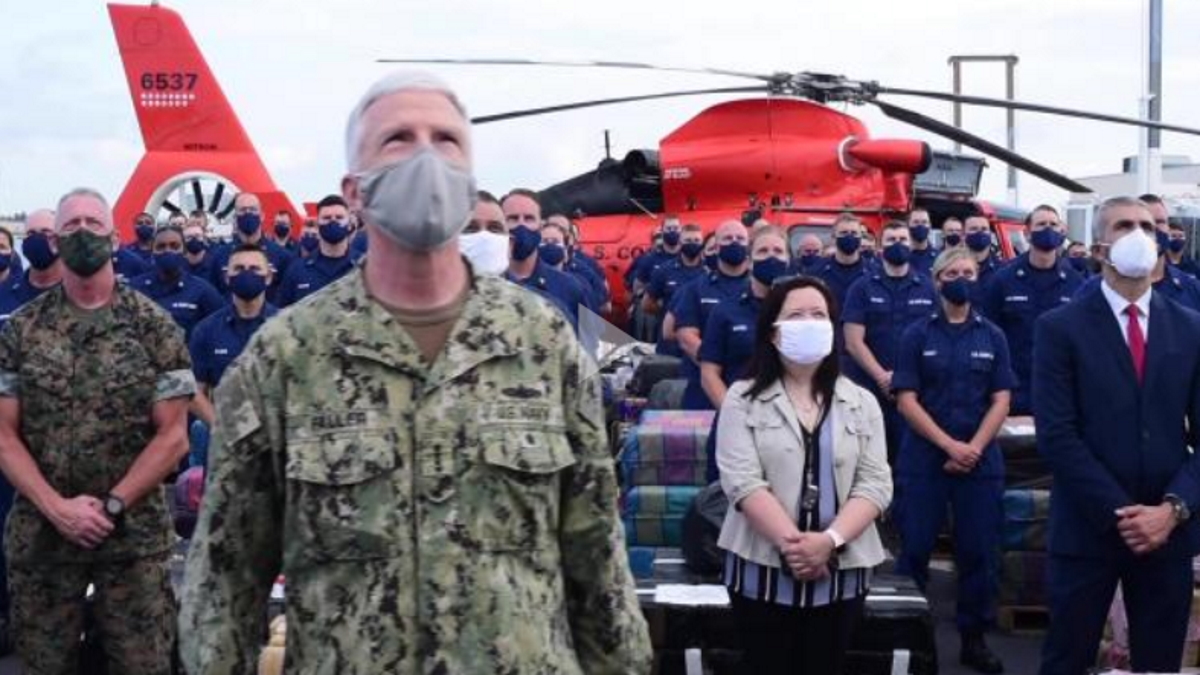
The Coast Guard Cutter James (WMSL-754) crew offloaded approximately 23,000 pounds of cocaine and approximately 6,900 pounds of marijuana, all worth more than an estimated $408 million, on Tuesday in Port Everglades.


The Coast Guard Cutter James (WMSL-754) crew offloaded approximately 23,000 pounds of cocaine and approximately 6,900 pounds of marijuana, all worth more than an estimated $408 million, on Tuesday in Port Everglades.

The drugs were interdicted in international waters of the Eastern Pacific Ocean off the coasts of Mexico, Central and South America, and in the Caribbean Sea including contraband seized and recovered during 11 interdictions of suspected drug smuggling vessels by four Coast Guard cutters and two U.S. Navy ships:

“The roughly 15 tons of illicit narcotics being offloaded here today and the likely ensuing prosecutions, are the results of extraordinary teamwork and intelligence-driven operations,” said Adm. Karl Schultz, commandant of the Coast Guard. “It is important to note that our fellow citizens aren’t the only ones who benefit from these counter-narcotics efforts. Our Central American neighbors face tremendous strain from drug-fueled violence sparked by transnational criminal organizations. Efforts like this enhanced counter-drug operation significantly disrupt the criminal activity destabilizing the region.”

On April 1, U.S. Southern Command began enhanced counter-narcotics operations in the Western Hemisphere to disrupt the flow of drugs in support of Presidential National Security Objectives.

Numerous U.S. agencies from the Departments of Defense, Justice and Homeland Security cooperated in the effort to combat transnational organized crime.

The Coast Guard, Navy, Customs and Border Protection, FBI, Drug Enforcement Administration, and Immigration and Customs Enforcement, along with allied and international partner agencies, play a role in counter-drug operations. 

The fight against drug cartels in the Eastern Pacific Ocean and the Caribbean Sea requires unity of effort in all phases from detection, monitoring and interdictions, to criminal prosecutions by international partners and U.S. Attorneys’ Offices in districts across the nation.

The law enforcement phase of counter-smuggling operations in the Eastern Pacific Ocean is conducted under the authority of the Coast Guard 11th District, headquartered in Alameda, California, and the law enforcement phase of operations in the Caribbean is conducted under the authority of the Coast Guard 7th District, headquartered in Miami.

The interdictions, including the actual boardings, are led and conducted by members of the U.S. Coast Guard. 

The cutter James is a 418-foot national security cutter home ported in Charleston, South Carolina.

The cutter Mohawk is a 270-foot medium endurance cutter home ported in Key West, Florida.  

The cutter Escanaba is a 270-foot medium endurance cutter home ported in Boston. The cutter Confidence is a 210-foot medium endurance cutter home ported in Port Canaveral, Florida.

The USS Pinckney is a 510-foot Arleigh Burke-class destroyer home ported in Naval Base San Diego.

The USS Lassen is a 510-foot Arleigh Burke-class destroyer home ported in Naval Station Mayport, Florida.

US Coast Guard (June 2020) Coast Guard Cutter James offloads approximately 30,000 pounds of cocaine, marijuana at Port Everglades

Experts Predict Artificial Intelligence Will Transform Warfare

Artificial intelligence will increasingly and dramatically improve systems across the Defense Department, the director of the Joint Artificial Intelligence Center said.


Artificial intelligence will increasingly — and dramatically — improve systems across the Defense Department, the director of the Joint Artificial Intelligence Center said.

Army Lt. Gen. John N.T. ”Jack” Shanahan spoke remotely from the Pentagon yesterday with Dave Deptula, dean of the Mitchell Institute for Aerospace Studies.

”It is my conviction and deep passion that AI will transform the character of warfare in the Department of Defense in the course of the next 20 years,” Shanahan said. ”There is no part of the department that will not be impacted by this, from the back office to the battlefield, from under sea to cyberspace and outer space, and all points in between.”

Artificial intelligence, often called AI, has been happening in commercial industry, but that effort only started in earnest in the department about 10 years ago, he noted, but ”we’ve been stuck in first gear in terms of fielding.”

​DOD has long struggled with how to take the world’s best research and development and field it at speed and at scale, he added.

Since the Joint Artificial Intelligence Center began operations about two years ago, all of the foundational elements have been put into place, Shanahan said, noting that the center now has 185 employees with a $1.3 billion annual budget.

Shanahan elaborated on what artificial intelligence foundational elements mean —  including AI strategy, policy, ethics, coalition partnerships, rules of engagement, user testing and evaluation.

All those elements were brought into the Joint Artificial Intelligence Center, where integrated product teams for projects do all of that work simultaneously, as opposed to sequentially, he said. ”In the department, those tend to happen in very different places, and sometimes they don’t happen at all.”

The center’s initiatives are focused on lower-consequence, lower-risk missions such as preventive maintenance, humanitarian assistance, defensive cyber and business process transformation, he said.

But perhaps the most important current focus is on joint warfighting operations, he said.

Over the next one to two years, the goal will be delivery of these AI-enabled systems to the warfighter, he said. ”We have to show we’re making a difference,” he added.

Shanahan said moving the department from being an industrial age, hardware-driven force to being an information-age, software-driven, more risk-tolerant one won’t be easy. Nor will it be easy to choose where to take those risks and how to take those risks, he said.

”We’re dealing with 60 years of legacy systems, legacy workflows, legacy talent management. You can’t just bolt those cutting-edge technologies onto … legacy equipment and expect to transform the Department of Defense,” he said, adding that, culturally, AI has to be in the fabric of the department and what DOD does every single day.

Defense.gov (June 2020) Experts Predict Artificial Intelligence Will Transform Warfare

Chinese Nationals Sentenced to Prison for Illegal Photography of U.S. Naval Installation in Key West, Florida

Three People’s Republic of China (PRC) foreign nationals were sentenced today to prison terms for illegal photography of military installations at the U.S. Naval Air Station in Key West, Florida (NAS Key West).


On Friday, Ariana Fajardo Orshan, U.S. Attorney for the Southern District of Florida and George L. Piro, Special Agent in Charge, Federal Bureau of Investigation (FBI), Miami Field Office announced that three People’s Republic of China (PRC) foreign nationals were sentenced today to prison terms for illegal photography of military installations at the U.S. Naval Air Station in Key West, Florida (NAS Key West).  

Lyuyou Liao,27, was sentenced to the statutory maximum term of 12 months in prison followed by one year of supervised release, after pleading guilty to illegally entering NAS Key West on December 26, 2019, and taking photographs and video footage of property on the Truman Annex of the station.

This included taking images of vital military equipment. (Case No. 20-10002-CR-KMM ).

In a separate case, Jielun Zhang,25,and Yuhao Wang,24, were sentenced to 12 months and nine months in prison, respectively, to be followed by one year of supervised release, after pleading guilty to illegally entering NAS Key West on January 4, 2020, and taking photographs of military and naval infrastructure located on the Sigbsbee Park and Trumbo Point Annexes of the station. (Case No. 20-10005-CR-KMM).  

U.S. Attorney Fajardo Orshan commended the investigative efforts of the FBI and the South Florida Joint Terrorism Task Force (JTTF). 

She also commended the Naval Criminal Investigative Service and the Key West Police Department for their assistance.   Assistant U.S. Attorney Jonathan Kobrinski prosecuted this case. 

Related court documents and information may be found on the website of the District Court for the Southern District of Florida at www.flsd.uscourts.gov or at http://pacer.flsd.uscourts.gov.

Justice.gov (June 2020) Three Chinese Nationals Sentenced to Prison for Illegal Photography of U.S. Naval Installation in Key West, Florida

Space Force Officials, Spacecom, Discuss Planetary Defense and Astronaut Launch

It’s possible that one day an asteroid may threaten the Earth and the threat would need to be mitigated, possibly by the U.S. military.


It’s possible that one day an asteroid may threaten the Earth and the threat would need to be mitigated, possibly by the U.S. military. It’s a scenario considered in a paper titled “Whither Space Power?” co-authored by two Air Force officers in 2002.

“Should be found on a collision course, whose job should it be to divert the threat, and how?” wrote Air Force Maj. Gen. John Shaw — then a major — and his co-author, Air Force Brig. Gen. Simon Worden. “It is our view that an organization the people have placed their lives in the hands of for the past several centuries — the U.S. military — is best suited to provide protection from either natural or man-made threats.”

Today, Shaw is dual-hatted as commander of the Combined Force Space Component within U.S. Space Command, and also serves as commander of Space Operations Command within the newly created U.S. Space Force.

During a June 1 webinar sponsored by SpaceNews, he explained what “planetary defense” is.

“Planetary defense, as we talk about it in the space community today, refers to defense of the planet against asteroids, natural threats … that could potentially collide with the Earth with calamitous results,” Shaw said.

Shaw said today NASA has an office responsible for cataloging things within the solar system that potentially could threaten the Earth.

While he said that years ago he was on board with the idea that the Defense Department might be primarily responsible for dealing with those kinds of threats to the planet, today he has more of an open mind about how those threats might be mitigated.

“We’re happy to team with NASA in that regard,” he said. “If a small asteroid or meteorite did hit the Earth, there would be some sort of emergency management response on the part of our nation to support wherever that landed, and the Department of Defense would be happy to be a teammate in that regard.”

Shaw also discussed the May 30 launch of NASA astronauts Air Force Col. Robert L. Behnken and retired Marine Corps Col. Douglas G. Hurley into space from Kennedy Space Center in Florida as part of NASA’s Demo-2 mission.

An important part of that launch, he said, involved Defense Department personnel being ready to recover those astronauts if the mission failed and they had to return to Earth. The Defense Department has done the mission before — for the space shuttle, he noted, but it’s been a long time since recovery personnel have had to be ready to retrieve astronauts from a capsule such as the “Crew Dragon” craft that was used in the Demo-2 mission.

“We really [had] to go back to 1975 to remember when we were last supporting capsules for personal recovery operations,” he said. “And that’s a whole different profile in terms of mission planning and contingency scenarios than the shuttle.”

The space shuttle, he said, could maneuver and land at an airfield, if needed. Not so with a capsule.

“A capsule doesn’t have that maneuverability, but it has the possibility of landing just about anywhere, and it can land just about anywhere,” he said. “That means our ability to support that … has to be able to cover that total footprint, and that’s different.”

Air Force Lt. Col. Michael Thompson serves as commander of Detachment 3 of the 45th Space Wing’s 45th Operations Group. His detachment was responsible for being ready if anything went wrong with the Demo-2 mission and astronauts needed to be retrieved.

“The last two years have really been kind of the fourth quarter, getting ready for this,” he said. “We’ve been working with Boeing and SpaceX, especially SpaceX, over the last year as we finalized and put the finishing touches on the tactics, techniques and procedures for this rescue scenario.”

Thompson said his detachment is actually small — about 30 people. And for the last year that small team was preparing for the launch of the Demo-2 mission. When the launch approached, he said, “Task Force 45” stood up, and the team grew to about 150 personnel. That’s still much smaller than what was available in the 1970s for Apollo missions, he said, which included as many as 6,000 personnel, 24 aircraft and seven Navy ships.

“Today we posture, like I said, 150 members,” he said. They also have eight aircraft at their disposal, in three different locations.

“Over the last couple years, we’ve been putting those plans together,” he said. “We went through this last weekend. It went exactly as we had planned, where we were on alert … once the Merlin engines fired up. That’s really when our mission began.”

He said the team is ready for medical evacuation support three hours prior to liftoff, but it’s when the rocket fires up that they are really expected to be ready to go.

“It’s really exciting, you know, to see that the team of professionals here are some of the best,” Thompson said. “When we talk about combat search and rescue professionals worldwide, these are the men and women that we look to. The same pararescuemen that are saving lives in the combat theater in Iraq, have been in Afghanistan, doing global ops, those are the same pararescuemen that are here executing this mission.”

Air Force Brig. Gen. Douglas A. Schiess, commander of 45th Space Wing, said the May 30 launch involved weather issues up until about 30 minutes prior, and that there had also been issues with the Eastern Range that supports both Cape Canaveral and the Kennedy Space Center in Florida. Those issues, he said, had been cleared up by range technicians in time for successful launch, however.

“Once we got about four minutes to go, I knew we were going to be good,” Schiess said. “Then my activity really was focused on Task Force 45, where the men and women of Det. 3 and airmen across the Air Force came together, and across the world.”

Det. 3, he said, had been preparing for its mission for several years.

“This team, they are a bunch of rescue experts and they do an incredible job,” he said. “I can’t just say anymore how proud I am of the men and women of the 45th Space Wing, Det. 3, and the Task Force 45 for the efforts that we did over the last couple weeks, and specifically this weekend, all the way up to docking and then watching our two astronauts, Bob and Doug, go through the hatch into the International Space Station.”

Defense.gov (June 2020) Spacecom, Space Force Officials Discuss Planetary Defense, Astronaut Launch

Top Enlisted Advisor to Joint Chiefs of Staff Chairman Joins Forces with FitOps to Fight Veteran Suicide Amid COVID-19


Comes as mental health check-ins and unemployment increase among veterans FitOps helps veterans find purpose through fitness

The former top enlisted advisor to the Chairman of the Joint Chiefs of Staff has joined forces with the FitOps Foundation to help prevent and end veteran suicide – an epidemic that has become more severe amid COVID-19.

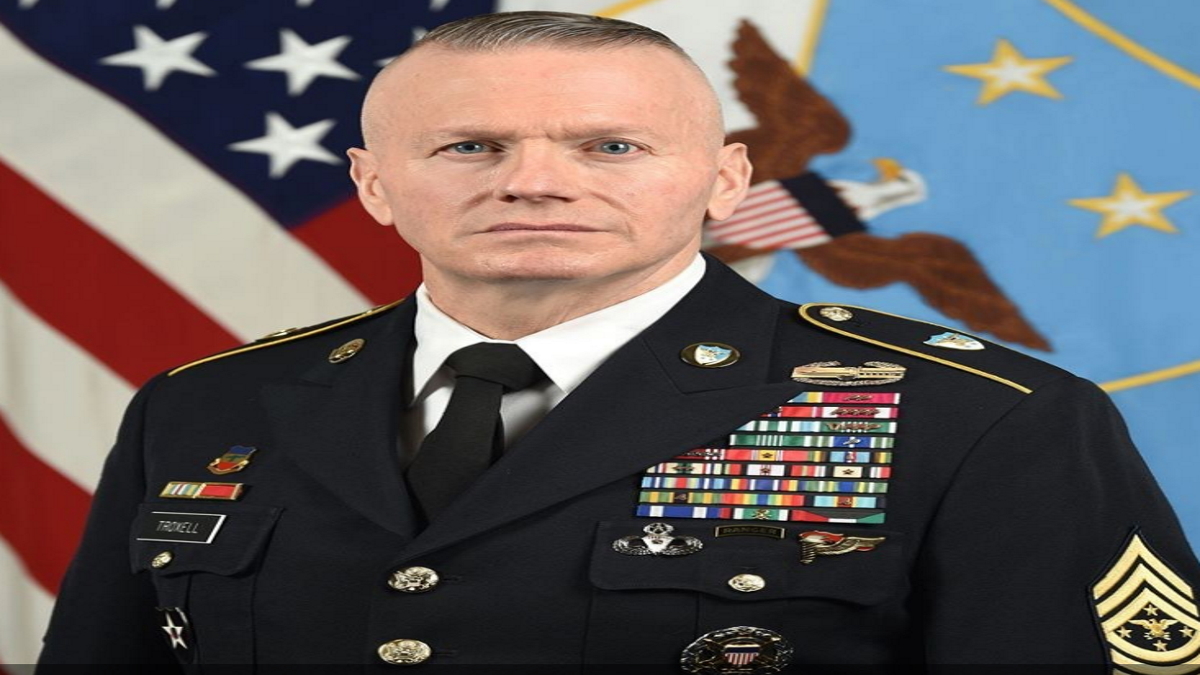
John Wayne Troxell, who for the past four years served as the Senior Enlisted Advisor to the Chairman of the Joint Chiefs of Staff (SEAC) and senior non-commissioned officer in the U.S. Armed Forces, will lead the FitOps strategic advisors board. FitOps helps veterans find purpose through fitness by training and certifying them as elite personal trainers at its camp in Arkansas.

“Even before COVID-19, too many veterans lost their reason for being, to serve others and struggled to transition to civilian life. Now the need is even greater,” John Wayne Troxell said. “Ending the veteran suicide epidemic is my new mission, and few organizations have had the impact FitOps has had in saving lives.”

In his new role, Troxell will help the foundation with its current efforts as veterans are acutely feeling the effects of the coronavirus. More than 1 million veterans filed for unemployment benefits in April, remote mental health appointments have skyrocketed, and reports warn that many industries that employ veterans could be more vulnerable to layoffs. An average of 20 veterans take their own lives each day, 1.5 times higher than the national average.

Troxell will also work to help FitOps reach service members who plan to separate from the military and equip them with training prior, so that when they hit the ground as a civilian, they are equipped to immediately serve their communities again, this time as personal trainers and coaches.

“We are very fortunate that SEAC Troxell has joined forces with us. As someone who gave 38 years of distinguished service and rose to the very top of the military, for him to make his next mission helping veterans find purpose again through fitness, sends a serious message,” FitOps Founder and veteran Matt Hesse said.

“I have witnessed firsthand the transformative power of knowing one’s purpose and using fitness to pursue it. Our mission is clear: We will not rest until we solve the veteran suicide epidemic.”

Before his retirement in December 2019, Troxell advised the Chairman of the Joint Chiefs of Staff and Secretary of Defense for four years on all matters involving joint and combined total force integration, utilization, health of the force and joint development for enlisted personnel. Troxell enlisted in the U.S. Army in 1982.

Since the COVID-19 pandemic began, FitOps has helped its graduates transition to virtual fitness sessions so they can still provide personal training sessions and classes to clients.

The FitOps Foundation was created in 2016 by Hesse and since has graduated hundreds of veterans with a current waitlist of 2,200. At the month-long camps, veterans learn exercise physiology and business skills to become Certified Veteran Fitness Operatives (CVFOs). After graduation, through partnerships across the country, FitOps helps their CVFOs get jobs in the fitness industry at clubs such as Performix House and 24 Hour Fitness. The graduate network extends as far as Alaska and Japan. CVFOs also receive counseling and transition assistance as they continue on their journey to civilian life from military service.

For more information on the FitOps Foundation, please visit www.fitops.org.

Contact: FitOps Communications Alexandra Hesse, ahesse@corrjensen.com /970 376 8155 

FitOps PR Newswire (May 2020) Top Enlisted Advisor to Joint Chiefs of Staff Chairman Joins Forces with FitOps