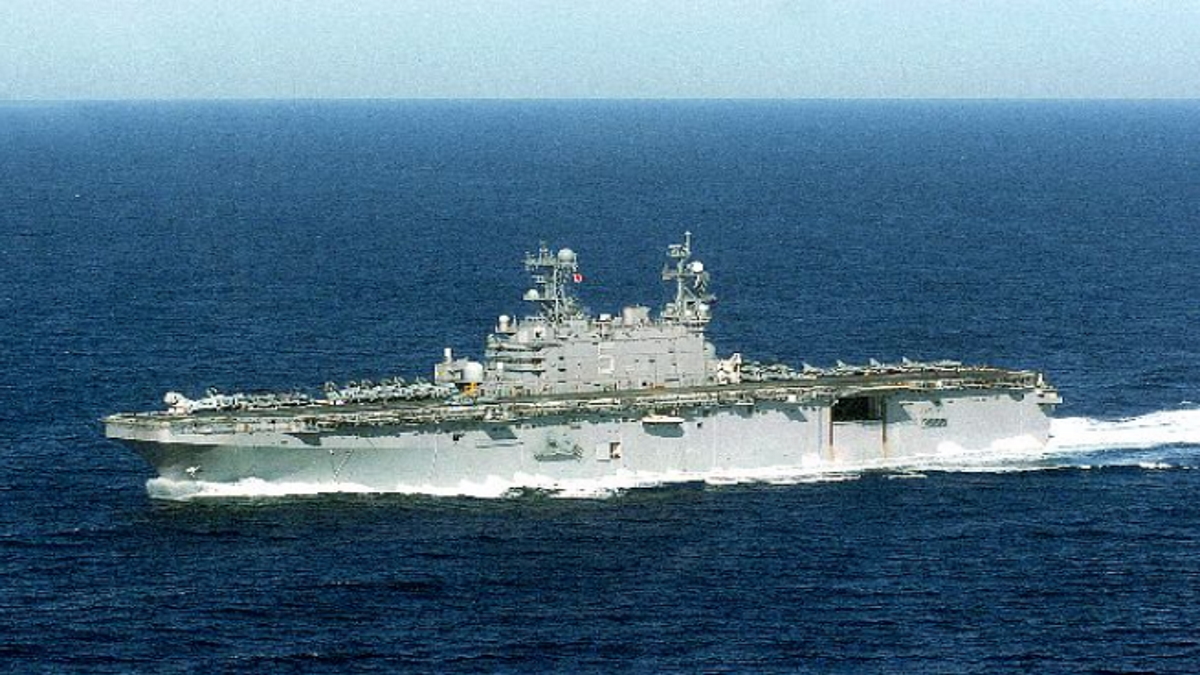
U.S. Navy Amphibious Assault Ship USS Tripoli Joins the Fleet

Although the Navy canceled the traditional public commissioning ceremony due to public health and safety restrictions on large public gatherings, the Navy commissioned the USS Tripoli administratively and the ship transitioned to normal operations.


Although the Navy canceled the traditional public commissioning ceremony due to public health and safety restrictions on large public gatherings, the Navy commissioned the USS Tripoli administratively and the ship transitioned to normal operations.

Meanwhile, the Navy is looking at a future opportunity to commemorate the special event with the USS Tripoli’s sponsor, crew and commissioning committee.

“USS Tripoli is proof of what the teamwork of all of our people – civilian, contractor and military – can accomplish together,” said Secretary of the Navy Kenneth J. Braithwaite. “This ship will extend the maneuverability and lethality of our fleet to confront the many challenges of a complex world, from maintaining the sea lanes to countering instability to maintaining our edge in this era of renewed great power competition.”

Rear Adm. Philip E. Sobeck, commander, Expeditionary Strike Group THREE, welcomes the Navy’s newest amphibious assault ship, and crew, to the amphibious force.

“Tripoli is an example of the continued investment in our Navy, to increase and maintain our edge on the battlefield,” said Sobeck. “Congratulations to Tripoli’s crew for all of your hard work, amidst these challenging times, to reach this milestone. We welcome you to the amphibious force, of combat ready ships and battle-minded crews to go to sea and support sustained combat operations.”

LHA 7 incorporates key components to provide the fleet with a more aviation-centric platform. Tripoli’s design features an enlarged hangar deck, realignment and expansion of the aviation maintenance facilities, a significant increase in available stowage for parts and support equipment, and increased aviation fuel capacity.

The ship is the first LHA replacement ship to depart the shipyard ready to integrate the entire future air combat element of the Marine Corps, to include the Joint Strike Fighter.

Along with its pioneering aviation element, LHA 7 incorporates gas turbine propulsion plant, zonal electrical distribution, and fuel-efficient electric auxiliary propulsion systems first installed on USS Makin Island (LHD 8). LHA 7 is 844 feet in length, has a displacement of approximately 44,000 long tons, and will be capable of operating at speeds of over 20 knots.

Tripoli’s commanding officer, Capt. Kevin Myers, highlighted Tripoli’s accomplishments over the past several months getting through initial sea trials.

The hard work and dedication of the entire team during the past few years was evident in the successful execution of at-sea testing.

“Being the third ship to bear the Tripoli namesake is a profound honor and this crew stands ready to carry on the legacy of our longstanding Navy and Marine Corps amphibious community,” said Meyers. “These sailors and Marines will pave the way for those still to come. What’s remarkable is seeing the dedication, perseverance and resilience these new plank owners have shown since day one and more recently, through uncertain times as the Navy and nation work through a pandemic. There is no doubt in my mind that this team is ready to answer the nation’s call at any time or place.”

LHA 7 is the third Navy ship to be named Tripoli.

The name honors and commemorates the force of U.S. Marines and approximately 370 soldiers from 11 other nationalities who captured the city of Derna, Libya, during the 1805 Battle of Derna.

The battle resulted in a subsequent peace treaty and the successful conclusion of the combined operations of the First Barbary War, and was later memorialized in the Marines’ Hymn with the line, “to the shores of Tripoli.”

Blogs to Follow:

Defense.gov (July 2020) The U.S. Navy commissioned USS Tripoli (LHA 7), today, July 15, 2020
OIG Statement on Louis A. Johnson VA Medical Center in Clarksburg, West Virginia

VA Inspector General Michael Missal, US Attorney for the Northern District of West Virginia Bill Powell, and other law enforcement partners announced today that Reta Mays, of Harrison County, West Virginia, pleaded guilty to seven counts of second-degree murder in the deaths of seven veterans at the Louis A. Johnson Veterans Affairs Medical Center in Clarksburg, West Virginia.


VA Inspector General Michael Missal, US Attorney for the Northern District of West Virginia Bill Powell, and other law enforcement partners announced today that Reta Mays, of Harrison County, West Virginia, pleaded guilty to seven counts of second-degree murder in the deaths of seven veterans at the Louis A. Johnson Veterans Affairs Medical Center in Clarksburg, West Virginia.

Mays, a nursing assistant, also pleaded guilty to one count of assault with intent to commit murder involving the death of an eighth veteran.

Mays admitted to administering insulin to several patients with the intent to cause their deaths.

Photo: Reta Mays, of Harrison County, West Virginia

What occurred at the Louis A. Johnson VA Medical Center is tragic and heartbreaking.

This case is particularly shocking because these deaths were at the hands of a nursing assistant who was entrusted with providing compassionate and supportive care to veterans.

Our thoughts and prayers are with the families of the victims. Within a matter of days of learning of the suspicious deaths at the facility, VA OIG agents identified the defendant as a person of interest.

Former VA Hospital Nursing Assistant Admits to Murdering Seven Veterans and Assault with Intent to Commit Murder of an Eighth

Working with medical facility leaders, the defendant was immediately removed from patient care. Without critical investigative actions being taken so expeditiously, additional lives could have been lost.

This was a complex investigation that involved a close partnership between the VA Office of Inspector General, US Attorney Bill Powell’s Office and the FBI, with the invaluable assistance of the West Virginia State Police and the Greater Harrison County Drug and Violent Crimes Task Force.

These collaborations resulted in solving this series of heinous crimes against veterans and providing some measure of closure for the victims and their families.

The result today was due to the tireless and dedicated efforts of the VA OIG law enforcement team, particularly lead Special Agent Keith Vereb, under the leadership of Resident Agent in Charge Colin Davis and Special Agent in Charge Kim Lampkins.

Our investigators painstakingly sought, tested, and pieced together an overwhelming amount of evidence to create the foundation for this case.

For example, the investigation included:

  • Extensive forensic audits and analyses, data modeling, and exhaustive medical record reviews
  • Approximately 350 interviews
  • More than 60 subpoenas and search warrants on electronic media
  • Approximately 1,200 current and former employee time-card reviews
  • Reviews of about 670,000 VA employee emails and multiple years of swipe card access logs for multiple personnel
  • Forensic analyses for various insulin and tissue samples by multiple experts
  • Coordinated disinterment’s and reinternments, with family agreement (including full military honors per family request), and witnessed associated autopsies.

The fact that the defendant pleaded guilty today to seven counts of second-degree murder is a testament to the strength of the case developed by our criminal team through their diligence, tenacity, and skill.

Blogs to Follow:

Justice.gov (July 2020) OIG Statement on Louis A. Johnson VA Medical Center in Clarksburg, West Virginia

Former VA Hospital Nursing Assistant Admits to Murdering Seven Veterans and Assault with Intent to Commit Murder of an Eighth

A former nursing assistant pled guilty today in federal court here to murder and assault charges in the deaths of eight veterans at the Veterans Affairs Medical Center (VAMC) in Clarksburg, West Virginia, U.S. Attorney Bill Powell announced.


A former nursing assistant pled guilty today in federal court here to murder and assault charges in the deaths of eight veterans at the Veterans Affairs Medical Center (VAMC) in Clarksburg, West Virginia, U.S. Attorney Bill Powell announced.

Reta Mays, 46, of Harrison County, West Virginia, pled guilty today to seven counts of second degree murder in the deaths of veterans Robert Edge, Sr., Robert Kozul, Archie Edgell, George Shaw, W.A.H., Felix McDermott, and Raymond Golden.

She pled guilty to one count of assault with Intent to commit murder” involving the death of veteran R.R.P.

“In today’s plea agreement, the defendant has admitted to actions that ended the lives of several military veterans who served our country honorably.  Our investigation never lost sight of each of these lives and the sacrifices these men made for their country.  The investigative work and the time it took to do it was always done with an eye towards honoring these men. Though we can’t bring these men back because of her evil acts, we hope the conclusion of the investigation and guilty plea helps ease the pain of the victims’ families,” said Powell.  “I want to thank the incredible work by the FBI, the VA-OIG, the West Virginia State Police, the Greater Harrison Drug & Violent Crimes Task Force and our prosecution team.  I also want to especially thank Attorney General Barr, and the families of the victims who never wavered in their support of this investigation.  We look forward to the conclusion of this matter at the sentencing, where we will be seeking the maximum penalty.”

Mays was employed as a nursing assistant at the VAMC, working the night shift during the same period of time veterans in her care died of hypoglycemia while being treated at the hospital.

OIG Statement on Louis A. Johnson VA Medical Center in Clarksburg, West Virginia

Nursing assistants at the VAMC are not qualified or authorized to administer any medication to patients, including insulin. Mays admitted to administering insulin to several patients with the intent to cause their deaths.

“These cases are tragic and heart breaking,” said Veterans Affairs Inspector General Michael J. Missal. “I thank the VA OIG agents and our law enforcement partners who worked tirelessly to ensure justice was served and that the victims’ families have some measure of closure. They are in our thoughts and prayers as we work with VA to help prevent anything like this from ever happening again.”

“When you break the trust you’re given as a medical professional and break the law, there are consequences,” said FBI Special Agent in Charge Michael Christman. “This was a lengthy and thorough investigation with hundreds of interviews, extensive medical and administrative records to review and forensic testing that needed to be done. These eight Veterans deserved respect and honor. They served our country and we all owe them a debt of gratitude. They didn’t deserve to die at the hands of a nursing assistant who intentionally inflicted pain on them and their families. I commend the work of my agents and our law enforcement partners with the Veterans Affairs Office of Inspector General.” 

Mays faces up to life in prison for each count of second-degree murder and faces up to 20 years in prison for assault with intent to commit murder.

Under the Federal Sentencing Guidelines, the actual sentence imposed will be based upon the seriousness of the offenses and the prior criminal history, if any, of the defendant.

Assistant U.S. Attorneys Jarod J. Douglas and Brandon S. Flower are prosecuting the case on behalf of the government. The Veterans Affairs Office of Inspector General and the FBI investigated. The West Virginia State Police and the Greater Harrison Drug & Violent Crimes Task Force, a HIDTA-funded initiative, assisted.

U.S. District Judge Thomas S. Kleeh presided.

Blogs to Follow:

Justice.gov (July 2020) Former VA Hospital Nursing Assistant Admits to Murdering Seven Veterans and Assault with Intent to Commit Murder of an Eighth

Virginia Defense Contractor Facing Federal Indictment in Maryland for Selling Chinese-Made Body Armor and Related Goods to Federal Agencies

A federal grand jury in Maryland has returned an indictment charging Arthur Morgan, age 67, of Lorton, Virginia, with federal wire fraud charges, in connection with federal contracts to provide helmets, body armor, and other items to military and other federal entities. The indictment was returned on July 6, 2020.


Allegedly Falsely Certified that the Products Were Manufactured in Countries Approved Under Federal Regulations, When He Knew They Were From China, Which is Not Approved

A federal grand jury in Maryland has returned an indictment charging Arthur Morgan, age 67, of Lorton, Virginia, with federal wire fraud charges, in connection with federal contracts to provide helmets, body armor, and other items to military and other federal entities.

The indictment was returned on July 6, 2020.

The indictment was announced by United States Attorney for the District of Maryland Robert K. Hur; Special Agent in Charge Eric D. Radwick of the General Services Administration (GSA) Office of Inspector General; Special Agent in Charge Ashan Benedict of the Bureau of Alcohol, Tobacco, Firearms and Explosives (ATF) Washington Field Division; Special Agent in Charge John A. Salazar, Naval Criminal Investigative Service; and Special Agent in Charge Marc A. Meyer of the U.S. Department of State Office of Inspector General.

According to the indictment, Morgan is the Chief Executive Officer of Surveillance Equipment Group Inc. (SEG) and its relevant division, SEG Armor, both of which Morgan managed from Lorton, Virginia .

The GSA enters into government-wide contracts with commercial firms to provide supplies and services that are available for use by federal agencies worldwide. All GSA contracts are subject to the Trade Agreements Act (TAA), which requires that all products listed on GSA contracts must be manufactured or “substantially transformed” in a “designated country.”

China is not a designated country under the TAA. Contractors were not allowed, under these contracts, to supply products that did not comply with the TAA. Any such products would have been disqualified from eligibility under the contract.

Further, a contractor’s failure to certify that its products complied with the TAA would have disqualified the contractor from eligibility for the contract. A contractor who falsely certified that a product was TAA compliant could not lawfully seek payment from the United States for that product.

The indictment alleges that Morgan falsely certified that the ballistic vests, helmets, riot gear, and other items he offered for sale were from designated countries, specifically, Hong Kong and the United States.

The indictment alleges that while representing that none of SEG’s products offered to federal agencies under the relevant contract were manufactured in China, Morgan knowingly provided products that Morgan knew had been manufactured in China, in violation of the TAA and the contract.

SEG received multiple federal government orders under the contract between 2003 and 2019. According to the indictment, between September 15, 2014 and August 29, 2019, approximately six federal government agencies placed at least 11 orders for ballistic and other law enforcement/security equipment from SEG—which SEG sourced from China in violation of the TAA, as part of the scheme to defraud— totaling approximately $658,866.92.

For example, the U.S. Navy placed an order with SEG for helmets, and Morgan had a series of e-mail communications with Navy contracting personnel in Indian Head, Maryland, including concerning SEG’s inability to meet the agreed-upon delivery schedule.

The indictment alleges that in his e-mails, Morgan falsely advised the Navy contracting personnel that SEG had a factory in southern Virginia, that the helmets for the order “were in production” there, and that the delays were due to a backorder of materials needed for the helmets.

The helmets that Morgan provided under the U.S. Navy order allegedly originated from China before Morgan sent them to the Navy, in violation of the TAA and the contract. Specifically, the indictment alleges that these products were manufactured by Chinese Company 1, from which Morgan knowingly ordered them.

On February 16, 2016, and March 10, 2016, the Defense Finance and Accounting Service paid SEG $127,069.60 and $191,990.28, respectively, for the U.S. Navy order. For all of the orders, federal government agencies paid SEG at least approximately $488,976.92.

If convicted, Morgan faces a maximum sentence of 20 years in federal prison for each of two counts of wire fraud. Actual sentences for federal crimes are typically less than the maximum penalties. A federal district court judge will determine any sentence after taking into account the U.S. Sentencing Guidelines and other statutory factors.

An indictment is not a finding of guilt. An individual charged by indictment is presumed innocent unless and until proven guilty at some later criminal proceedings.

United States Attorney Robert K. Hur commended the GSA OIG, the State Department OIG, the ATF, and the NCIS for their work in the investigation, and recognized the Army Major Procurement Fraud Unit, the Defense Criminal Investigative Service, Homeland Security Investigations, the FBI, the Air Force Office of Special Investigations, and the Coast Guard Investigative Service for their assistance.

Mr. Hur thanked Assistant U.S. Attorney Elizabeth Wright, who is prosecuting the case.

Blogs to Follow:

ATF.gov (July 2020) Virginia Defense Contractor Facing Federal Indictment in Maryland for Selling Chinese-Made Body Armor and Related Goods to Federal Agencies

USSF field command structure reduces command layers, focuses on space warfighter needs

The Department of the Air Force and the United States Space Force have finalized the new service’s organizational structure for echelons below the headquarters, reflecting the newest branch of the armed forces’ guiding principles of being a lean, agile and mission-focused organization.


U.S. Space Force organizes, trains, and equips space forces in order to protect and defend U.S. and allied interests in space and to provide space capabilities to the joint force.

The Department of the Air Force and the United States Space Force have finalized the new service’s organizational structure for echelons below the headquarters, reflecting the newest branch of the armed forces’ guiding principles of being a lean, agile and mission-focused organization.
 
The USSF field organization will consist of three echelons of command, where the Air Force currently is organized into five echelons. USSF’s organizational structure will initially consolidate and align all organize, train and equip mission execution from former Air Force space-related units.

“This is the most significant restructuring of space units undertaken by the United States since the establishment of Air Force Space Command in 1982,” said Secretary of the Air Force Barbara Barrett. “Innovation and efficiency are driving our mission as we position the Space Force to respond with agility to protect our nation’s space capabilities and the American way of life.”

In order of hierarchy, the USSF field echelons are named field commands, deltas and squadrons. There will be three field commands aligned with specific mission focuses: Space Operations Command, Space Systems Command, and Space Training and Readiness Command. SpOC and SSC will be led by three-star general officers, and STARCOM will be led by a two-star general.

Deltas will be O-6 led and will be organized around a specific function – operations, installation support, training, etc.

Within the deltas will be squadrons focused on specific tactics. When the field command structure is fully implemented, it will eliminate one general officer echelon and one O-6 echelon of command. Functions formerly performed at the eliminated echelons will be realigned where appropriate within the USSF. 

“This is an historic opportunity to launch the Space Force on the right trajectory to deliver the capabilities needed to ensure freedom of movement and deter aggression in, from and to space,” said Gen. Jay Raymond, USSF chief of space operations. “How we organize the Space Force will have a lasting impact on our ability to respond with speed and agility to emerging threats in support of the National Defense Strategy and Space Strategy.”

SpOC will be the primary force provider of space forces and capabilities for combatant commanders, coalition partners, the joint force and the nation. 

The staff and operations elements of USSF at Peterson Air Force Base, Colorado, which is also the former AFSPC, will become the headquarters SpOC.

There is an existing unit at Vandenberg AFB, California, named Space Operations Command, which will be renamed upon activation of the field command SpOC.

SSC will be responsible for developing, acquiring, and fielding lethal and resilient space capabilities for war-fighters.

Additionally, SSC will be responsible for launch, developmental testing, on-orbit checkout, and sustainment and maintenance of USSF space systems, as well as oversight of USSF science and technology activities. 

Acquisition and development organizations to include the Space and Missile Systems Center, the Commercial Satellite Communications Office, and program offices of space systems transferring to USSF from other DoD organizations will form the building blocks of the new command, which will be built out in the months to come.

STARCOM will train and educate space professionals, and develop combat-ready space forces to address the challenges of the war-fighting domain of space.  Complete stand up of STARCOM is scheduled for 2021. 

In the interim, a provisional Space Training and Readiness Delta, led by an O-6, will be established in July at Peterson AFB.  This unit will serve as the parent organization for a number of education, training, and operational test and evaluation units transferring to the Space Force in summer 2020.

The next activities to stand up USSF field organizations include activation of SpOC, SSC and deltas beginning later in summer. 

Blogs to Follow:

Spaceforce.mil (July 2020) USSF field command structure reduces command layers, focuses on space warfighter needs