CBP Assists US Law Enforcement Partners and British Royal Navy in $46.2 million in cocaine seizure in the Caribbean Sea

The US Customs and Border Protection (CBP) has reported that the British Royal Navy and U.S. law enforcement partners seized 1,400 kilograms (3,086) pounds of cocaine and detained nine suspected smugglers


The US Customs and Border Protection (CBP) has reported that the British Royal Navy and U.S. law enforcement partners seized 1,400 kilograms (3,086) pounds of cocaine and detained nine suspected smugglers following the interdiction of two separate drug smuggling events in the Caribbean Sea Jan. 24 and Jan. 30, 2020.

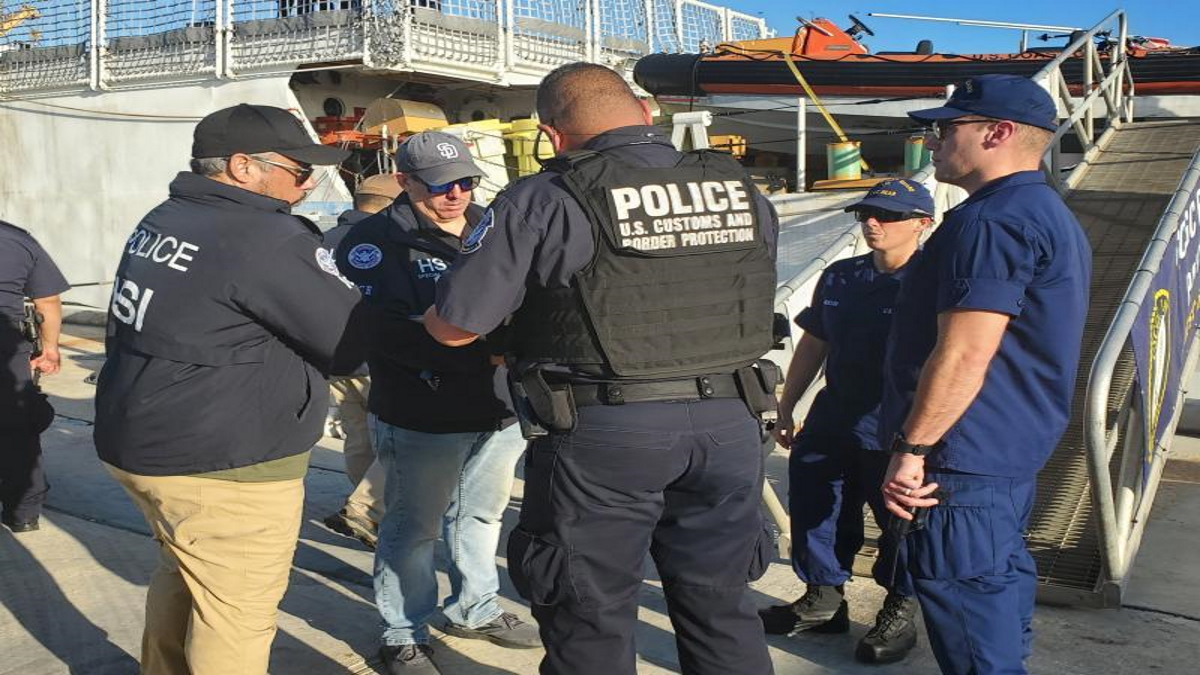
The US Coast Guard cutter Bear delivered the seized contraband and detainees from both cases to US Customs and Border Protection (CBP) officers, Immigration and Customs Enforcement (ICE)-Homeland Security Investigations, and Drug Enforcement Administration special agents in San Juan, Puerto Rico, Tuesday.

The interdiction was a result of an international, multi-agency law enforcement effort in support of Operation Unified Resolve, Operation Caribbean Guard, Campaign Martillo (a joint, inter-agency, 20-nation collaborative counter narcotic effort), and the Caribbean Corridor Strike Force (CCSF) and will be prosecuted by the U.S. Federal District Court for the District of Puerto Rico.

In the first interdiction, the United Kingdom’s Royal Navy RFA Mounts Bay, while on patrol with a U.S. Coast Guard Law Enforcement Detachment (LEDET) and a Coast Guard Helicopter Interdiction Tactical Squadron (HITRON) armed helicopter onboard, detected two suspicious go-fast vessels, approximately 74 nautical miles south of St. Croix, U.S. Virgin Islands.

The RFA Mounts Bay launched the Coast Guard HITRON helicopter and the ship’s pursuit vessel with the Coast Guard LEDET to interdict both suspect vessels. 

The Coast Guard LEDET boarding team, with the assistance of RFA Mounts Bay crew members, boarded the suspected vessels, apprehending the seven men and seizing 42 bales of suspected contraband. 

In the second interdiction, a marine patrol aircraft detected a northbound target of interest, southeast of Isla Beata, Dominican Republic. The cutter Bear along with a helicopter responded to interdict the go-fast.  Cutter Bear’s Over the Horizon cutter boat and embarked helicopter arrived on scene and stopped the go-fast.  Cutter Bear’s boarding team detained the two men aboard the go-fast, after discovering 13 bales of suspected contraband.

CBP is part of the Caribbean Border Strike Force (CCSF); an initiative of the U.S. Attorney’s Office created to disrupt and dismantle major drug trafficking organizations operating in the Caribbean. CCSF is part of the Organized Crime Drug Enforcement Task Force (OCDETF), which investigates South American-based drug trafficking organizations responsible for the movement of multi-kilogram quantities of narcotics using the Caribbean as a transshipment point for further distribution to the United States.

CBP.gov (February, 2020) CBP Assists US Law Enforcement Partners and British Royal Navy in $46.2 million in cocaine seizure in the Caribbean Sea

Help me maintain this news reporting blog by donating here.

DOJ Files Actions to Stop Telecom Carriers Who Facilitated Hundreds of Millions of Fraudulent Robocalls to American Consumers

The Department of Justice (DOJ) filed civil actions for temporary restraining orders today in two landmark cases against five companies and three individuals allegedly responsible for carrying hundreds of millions of fraudulent robocalls to American consumers, the Department of Justice announced.


First of its Kind Enforcement Action by the Justice Department

The Department of Justice (DOJ) filed civil actions for temporary restraining orders today in two landmark cases against five companies and three individuals allegedly responsible for carrying hundreds of millions of fraudulent robocalls to American consumers, the Department of Justice announced. 

The Department of Justice alleges that the companies were warned numerous times that they were carrying fraudulent robocalls — including government- and business-imposter calls — and yet continued to carry those calls and facilitate foreign-based fraud schemes targeting Americans.  The calls, most of which originated in India, led to massive financial losses to elderly and vulnerable victims across the nation. 

Assistant Attorney General Jody H. Hunt of the Justice Department’s Civil Division, U.S. Attorney Richard P. Donoghue of the Eastern District of New York, Inspector General Gail S. Ennis of the Social Security Administration (SSA) and Chief Postal Inspector Gary Barksdale, made the announcement.

The two cases announced today contain similar allegations.  The defendants in one case are Ecommerce National LLC d/b/a TollFreeDeals.com; SIP Retail d/b/a sipretail.com; and their owner/operators, Nicholas Palumbo, 38, and Natasha Palumbo, 33, of Scottsdale, Arizona. 

The defendants in the other case include Global Voicecom Inc., Global Telecommunication Services Inc., KAT Telecom Inc., aka IP Dish, and their owner/operator, Jon Kahen, 45, of Great Neck, New York.  In each case, the Department of Justice sought an order immediately halting the defendants’ transmission of unlawful robocall traffic.  A federal court has entered a temporary restraining order against the Global Voicecom defendants.

“Robocalls are an annoyance to many Americans, and those that are fraudulent and predatory are a serious problem, often causing devastating financial harm to the elderly and vulnerable members of our society,” said Assistant Attorney General Jody Hunt for the Department of Justice’s Civil Division.  “The Department of Justice will pursue to the fullest extent of the law individuals in the United States who knowingly facilitate imposter fraud calls, using both criminal and civil tools where appropriate.  And we look forward to working closely with law enforcement colleagues in India and elsewhere around the world to identify those behind these calls so that we can bring them to justice.” 

Americans have experienced a deluge of robocalls over the past several years.  Many of the robocalls originate abroad. 

Recently, foreign fraudsters have used robocalls to impersonate government investigators and to provide Americans with alarming messages, such as: the recipient’s social security number or other personal information has been compromised or otherwise connected to criminal activity; the recipient faces imminent arrest; their assets are being frozen; their bank and credit accounts have suspect activity; their benefits are being stopped; they face imminent deportation; or combinations of these threats. 

Each of these claims is a lie, designed to scare the call recipient into paying large sums of money.  Social Security imposters, IRS imposters, and tech-support schemes (in which callers impersonate legitimate technology companies) have proliferated in part because of the ease with which robocalls can reach millions of potential victims every hour.

In the cases announced today, the United States alleges that the defendants operated voice over internet protocol (VoIP) carriers, which use an internet connection rather than traditional copper phone lines to carry telephone calls.  Numerous foreign-based criminal organizations are alleged to have used the defendants’ VoIP carrier services to pass fraudulent government- and business-imposter fraud robocalls to American victims.  The complaints filed in the cases specifically allege that defendants served as “gateway carriers,” making them the entry point for foreign-initiated calls into the U.S. telecommunications system. 

The defendants carried astronomical numbers of robocalls.  For example, the complaint against the owners/operators of Ecommerce National d/b/a TollFreeDeals.com alleges that the defendants carried 720 million calls during a sample 23-day period, and that more than 425 million of those calls lasted less than one second, indicating that they were robocalls.  The complaint further alleges that many of the 720 million calls were fraudulent and used spoofed (i.e., fake) caller ID numbers. 

The calls facilitated by the defendants falsely threatened victims with a variety of catastrophic government actions, including termination of social security benefits, imminent arrest for alleged tax fraud and deportation for supposed failure to fill out immigration forms correctly.

According to allegations in both complaints, the defendants ignored repeated red flags and warnings about the fraudulent and unlawful nature of the calls they were carrying.

“We are using all available tools and resources to stop foreign call center scammers — and for the first time their U.S.-based enablers — from conning elderly and vulnerable victims in New York and throughout the United States,” said U.S. Attorney Richard Donoghue.  “Protecting individuals from schemes that result in catastrophic losses to the victims is a priority of this Office and the Department of Justice.”

“Today’s events are the culmination of months of hard work, and a critical step in holding these and other companies accountable for being the link between overseas scammers and their victims,” said SSA Inspector General Gail S. Ennis.  “We will continue to pursue those who exploit the U.S. telephone system and allow scammers to deceive consumers using the good name of Social Security.  I want to thank the Department of Justice’s Transnational Elder Fraud Strike Force and our law enforcement partners for their support throughout this investigation.”

“Anyone who engages in deceptive practices like imposter fraud should know, regardless of where they are, they will not go undetected and will be held accountable,” said Chief Inspector Gary Barksdale.  “We will continue to work alongside the Department of Justice and our other partners to prevent and deter ongoing harm.”

Trial Attorneys Ann Entwistle and Bart Dunn of the Civil Division’s Consumer Protection Branch and Assistant U.S. Attorneys Bonni Perlin, Evan Lestelle, and Dara Olds of the U.S. Attorney’s Office for the Eastern District of New York represent the United States.  The SSA’s Office of Inspector General, the U.S. Postal Inspection Service, the Office of Inspector General for Tax Administration, U.S. Immigration and Customs Enforcement’s Homeland Security Investigations New York El Dorado Task Force, U.S. Secret Service, New York Police Department and U.S. Customs and Border Protection collectively provided investigative support.The Federal Trade Commission and the Federal Communications Commission provided pertinent data.  

The claims made in the complaint are mere allegations that, if the case were to proceed to trial, the government must prove to receive a determination of liability.

Since President Trump signed the bipartisan Elder Abuse Prevention and Prosecution Act (EAPPA) into law, the Department of Justice has participated in hundreds of enforcement actions in criminal and civil cases that targeted or disproportionately affected seniors. 

In particular, in March 2019, the department announced the largest elder fraud enforcement action in American history, charging more than 260 defendants in a nationwide elder fraud sweep.  The department has likewise conducted hundreds of trainings and outreach sessions across the country since the passage of the Act.  

Justice.gov (Jan., 2020) The Department of Justice Files Actions to Stop Telecom Carriers Who Facilitated Hundreds of Millions of Fraudulent Robocalls to American Consumers

Help me maintain this news reporting blog by donating here.

Illegal alien sentenced to 25 years in prison for conspiracy to distribute methamphetamine and heroin

Ubaldo Soto-Diaz, an illegal alien from Mexico, but residing in Portersville, California, was sentenced to 25 years in prison for conspiracy to distribute methamphetamine and heroin


Ubaldo Soto-Diaz, an illegal alien from Mexico, but residing in Portersville, California, was sentenced to 25 years in prison for conspiracy to distribute methamphetamine and heroin, Special Agent in Charge (SAC) of U.S. Immigration and Customs Enforcement’s Homeland Security Investigations (HSI) Seattle Debra Parker and U.S. Attorney Bart M. Davis announced.

Chief U.S. District Judge David C. Nye also ordered Soto-Diaz to pay a $2,000 fine and serve five years of supervised release following his prison sentence. Soto-Diaz pleaded guilty to the charge on July 18, 2019.

According to court records, Soto-Diaz admitted that between August 28, 2018, and January 28, 2019, he conspired with six other defendants to distribute methamphetamine and heroin.

Soto-Diaz was found to be the leader and organizer of an extensive criminal organization that was responsible for distributing high potency methamphetamine, manufactured in Mexico and then transported from California to Idaho. During their investigation of Soto-Diaz and his organization, DEA agents seized over thirty pounds of 100% pure methamphetamine and almost two pounds of black tar heroin.

According to court records, Soto-Diaz had previously been convicted of transporting a controlled substance in 2000 and possession of controlled substances for sale in 2009. He was deported to Mexico on May 17, 2010. He was found to be illegally present in the United States on May 26, 2010, and was convicted of illegal entry.

He again illegally returned to the United States and was convicted of possession of controlled substances for sale and unlawful possession of a firearm in 2012. At the time Soto-Diaz conspired to distribute methamphetamine and heroin to Idaho, he was illegally living in Portersville, California.

This case was a result of a joint investigation with Drug Enforcement Administration, Nampa Police Department, Canyon County Narcotics Unit, and Ada County Sheriff’s Office.

This indictment is the result of a joint investigation by the Organized Crime and Drug Enforcement Task Force (OCDETF). The OCDETF program is a federal multi-agency, multijurisdictional task force that supplies supplemental federal funding to federal and state agencies.

The principal mission of the OCDETF program is to identify, disrupt and dismantle the most serious drug trafficking, weapons trafficking and money laundering organizations, and those primarily responsible for the nation’s illegal drug supply. Program participants include HSI; Federal Bureau of Investigation; Drug Enforcement Administration; Bureau of Alcohol, Tobacco, Firearms and Explosives; Internal Revenue Service-Criminal Investigation; and U.S. Marshals Service.

As the largest investigative agency within the U.S. Department of Homeland Security (DHS), HSI investigates and enforces more than 400 federal criminal statutes – more than any other U.S. law enforcement agency. HSI special agents use this authority to investigate cross-border criminal activity – including drug trafficking – and work in close coordination with local state and federal law enforcement agencies to target transnational criminal organizations (TCOs) that are bringing dangerous substances, such as illicit fentanyl, into the community.

ICE.gov (Feb., 2020)  Illegal alien sentenced to 25 years in prison for conspiracy to distribute methamphetamine and heroin

Help me maintain this news reporting blog by donating here.
Iranian National Charged with Bank Fraud and Lying to Federal Agents in Connection with a Scheme to Use the U.S. Financial System to Send More Than $115 Million to Iranian Individuals and Entities

Bahram Karimi was charged with conspiring to commit bank fraud, bank fraud, and making false statements in connection with his involvement in a joint project initiated by the Governments of Iran and Venezuela


The Department of Justice announced that Bahram Karimi was charged with conspiring to commit bank fraud, bank fraud, and making false statements in connection with his involvement in a joint project initiated by the Governments of Iran and Venezuela in which more than $115 million was illegally funneled through the U.S. financial system for the benefit of various Iranian individuals and entities. 

The case is assigned to U.S. District Judge Alison J. Nathan. 

“Karimi allegedly conspired in an infrastructure project initiated by the Governments of Iran and Venezuela,” said Assistant Attorney General for National Security John C. Demers. “He then lied to banks about Iranian involvement and took advantage of the U.S. financial system to benefit Iranian parties.  The Department of Justice will continue to prosecute those who misuse our financial system in violation of U.S. sanctions.”

“As alleged, Bahram Karimi knowingly and willfully facilitated the circumventing of sanctions against Iran, and then lied about it to FBI agents,” said U.S. Attorney Geoffrey S. Berman for the Southern District of New York. “Karimi allegedly enabled the concealed transfer through U.S. banks of more than $100 million from a Venezuelan state-owned company to an Iranian construction firm, and when questioned, told the agents he didn’t know that was prohibited by the sanctions.”

“At the end of the day, these charges reflect the use of our financial system to generate U.S. dollars for Iranians and Iranian entities.  That’s why our government has robust sanctions in place against Iran and Iranian entities who seek to use the U.S. banking system for their own benefit,” said Assistant Director-in-Charge William F. Sweeney, Jr of the New York Field Office of the Federal Bureau of Investigation (FBI).

As alleged in the Superseding Indictment and statements made in court filings and proceedings:

In August 2004, the Governments of Iran and Venezuela entered into a Cooperation Framework Agreement, whereby they agreed to cooperate in certain areas of common interest.  The following year, both governments supplemented the Cooperation Framework Agreement by entering into a Memorandum of Understanding regarding an infrastructure project in Venezuela (the “Project”), which was to involve the construction of thousands of housing units in Venezuela. 

The Project was led by Stratus Group, an Iranian conglomerate with international business operations in the construction, banking, and oil industries.  In December 2006, Stratus Group incorporated a company in Tehran, which was then known as the Iranian International Housing Corporation (IIHC). 

IIHC was responsible for construction for the Project. 

Thereafter, IIHC entered into a contract with a subsidiary of a Venezuelan state-owned energy company (the VE Company), which called for IIHC to build approximately 7,000 housing units in Venezuela in exchange for approximately $475,734,000.  Stratus Group created the Venezuela Project Executive Committee to oversee the execution of the Project.  Karimi was a member of the committee and was responsible for managing the Project in Venezuela.

In connection with his role on the Project, Karimi worked with others to defraud U.S. banks by concealing the role of Iranian parties in U.S. dollar payments sent through the U.S. banking system.  Specifically, between April 2011 and November 2013, the VE Company made approximately 15 payments to IIHC through two front companies, which were created to conceal the Iranian nexus to the payments, in violation of U.S. economic sanctions.  These 15 payments totaled approximately $115 million. 

In January 2020, Karimi was interviewed by, among other people, two FBI agents.  During that interview, Karimi falsely stated that, during the course of the Project, he believed that international sanctions against Iran did not apply to Iranian companies or persons.

Karimi, 53, of Canada, is charged with (1) conspiring to commit bank fraud, which carries a maximum sentence of 30 years in prison; (2) bank fraud, which carries a maximum sentence of 30 years in prison; and (3) making false statements, which carries a maximum sentence of five years in prison.  The maximum potential sentences in this case are prescribed by Congress and are provided here for informational purposes only, as any sentencing of the defendant will be determined by the judge.

Mr. Demers and Mr. Berman praised the outstanding investigative efforts of the New York County District Attorney’s Office and the FBI.  Mr. Berman also thanked the New York County District Attorney’s Office for their ongoing assistance in this investigation.

The prosecution of this case is being handled by the Office’s Terrorism and International Narcotics Unit.  Assistant U.S. Attorneys Jane Kim, Michael Krouse, and Stephanie Lake, and Special Assistant U.S. Attorney Garrett Lynch, Deputy Chief of the Major Economic Crimes Bureau at the New York County District Attorney’s Office, are in charge of the prosecution, with assistance from Trial Attorney Scott Claffee of the National Security Division’s Counterintelligence and Export Control Section.

The charges contained in the Superseding Indictment are merely allegations, and the defendant is presumed innocent unless and until proven guilty.

Justice.gov (Jan. 31, 2020).  Iranian National Charged with Bank Fraud and Lying to Federal Agents

Help me maintain this news reporting blog by donating here.

Wannabe Mass Shooters Sentenced

In 2018, they traveled to Columbine High School to visit the site of the 1999 school shooting, where they took pictures of themselves dressed like the shooters and posing with weapons.


Couple’s Obsession Led Them to Plan Attack

Elizabeth Lecron and Vincent Armstrong were obsessed with mass shooters

The Toledo, Ohio, couple immersed themselves in online subculture dedicated to the topic. In 2018, they traveled to Columbine High School to visit the site of the 1999 school shooting, where they took pictures of themselves dressed like the shooters and posing with weapons.

Lecron also wrote to one notorious mass shooter in prison to express her admiration for him.

But investigators say it wasn’t just a morbid fascination.

The couple, led by Lecron, wrote detailed plans making it clear they intended to become mass shooters themselves. They expressed violent, anti-government beliefs and their plans to act on them.

“Unfortunately, we address these types of threats frequently,” said Special Agent Ryan Presley, who oversaw this investigation out of the FBI’s Cleveland Field Office. “The challenge is figuring out who is just talking and who is making serious plans.”

In this case, the would-be shooters documented their violent plans.

Thankfully, a concerned citizen who became aware of their activity called the Toledo Police Department, which shared the tip with Detective Louie Espinosa and FBI Special Agent Sara Pedersen of the Bureau’s Joint Terrorism Task Force (JTTF).

The JTTF learned that the couple’s plans were serious and that they had stockpiled weapons and bomb-making materials.

Lecron and Armstrong had scouted out venues for their attacks. One was a Toledo business the couple frequented. They knew the business had few entrances and exits, which they thought would make it difficult for potential victims to escape. They discussed details down to the type of shoes they would wear and how to create a diversion at the scene.

With the overwhelming evidence against them, Lecron and Armstrong both pleaded guilty. Lecron admitted to providing material support to terrorism and was sentenced in November 2019 to 15 years in prison. Armstrong pleaded guilty to a lesser conspiracy charge and was sentenced in December 2019 to six years.

Lecron’s prosecution is believed to be the first time a material support charge—a very serious charge usually brought against international terrorism suspects—has been used in a domestic terrorism case. Presley attributed this to the work of the investigative team and partnership with the U.S. Attorney’s Office in the Northern District of Ohio.

And without the tip from the concerned citizen, this story could have ended in a mass shooting—instead, the two would-be shooters are behind bars.

“I can’t say enough good things about the Toledo Police Department,” Presley said. “They have created an environment in which citizens feel comfortable bringing these types of things forward. This is an example of why the JTTF model works—everyone worked together to keep our community safe from a potentially dangerous threat.”

Resources

FBI.gov (Jan. 2020).  Would-Be Mass Shooters Sentenced

Help me maintain this news reporting blog by donating here.