Fact Sheet: DHS Notice of Arrival Restrictions on China, Iran and Certain Countries of Europe


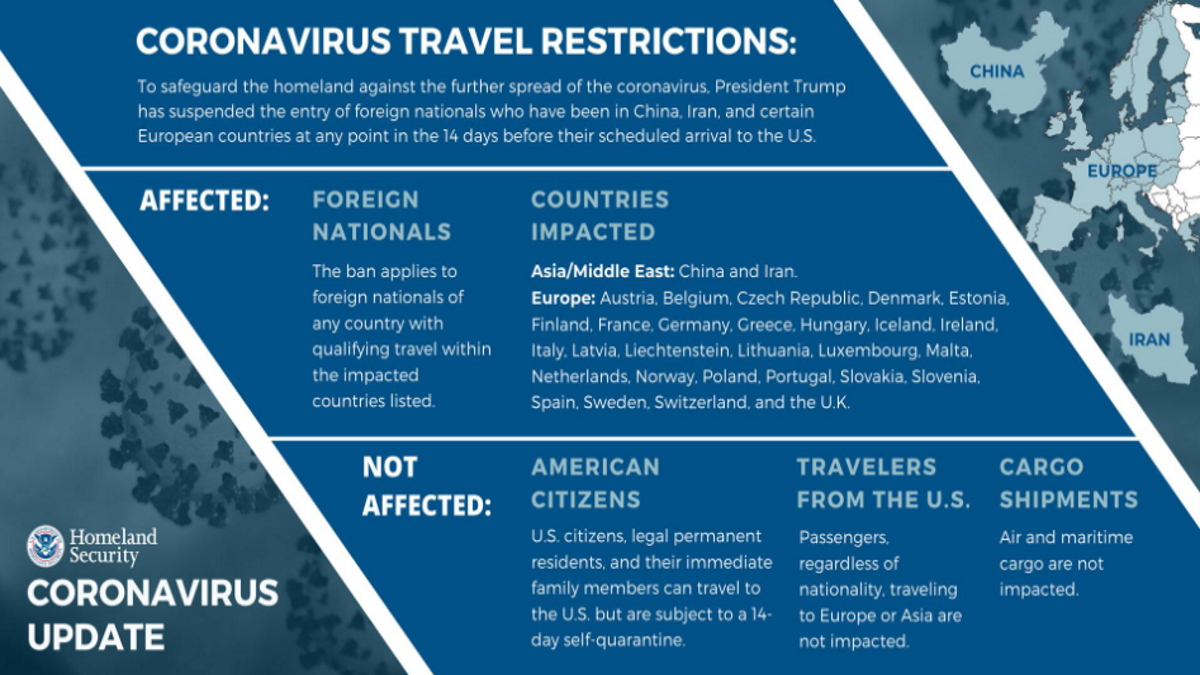
In furtherance of Presidential Proclamations 998499929993, and 9994, which bans the entry of non-U.S. citizens who are from or recently been in China, Iran, or certain European countries, the Department of Homeland Security issued a Notice of Arrival Restrictions requiring American citizens, legal permanent residents, and their immediate families who are returning home to the U.S. to travel through one of 13 airports upon arrival to the U.S., submit to an enhanced entry screening and self-quarantine for 14 days once they reach their final destination.

On March 11, 2020, President Trump determined that the potential for widespread transmission of the coronavirus by infected individuals seeking to enter the United States threatens the security of the homeland.  The President issued Proclamations 9984, 9992, and 9993, which suspends entry to nearly all foreign nationals who have been in China, Iran, and certain European countries at any point during the 14 days prior to their scheduled travel to the U.S.

These European countries include: Austria, Belgium, Czech Republic, Denmark, Estonia, Finland, France, Germany, Greece, Hungary, Iceland, Ireland, Italy, Latvia, Liechtenstein, Lithuania, Luxembourg, Malta, Netherlands, Norway, Poland, Portugal, Slovakia, Slovenia, Spain, Sweden, Switzerland, and the United Kingdom.

The order is now effective. Americans returning from the affected countries will now be required to travel through 13 airports:

  • Boston-Logan International Airport (BOS), Massachusetts
  • Chicago O’Hare International Airport (ORD), Illinois
  • Dallas/Fort Worth International Airport (DFW), Texas
  • Detroit Metropolitan Airport (DTW), Michigan
  • Daniel K. Inouye International Airport (HNL), Hawaii
  • Hartsfield-Jackson Atlanta International Airport (ATL), Georgia
  • John F. Kennedy International Airport (JFK), New York
  • Los Angeles International Airport, (LAX), California
  • Miami International Airport (MIA), Florida
  • Newark Liberty International Airport (EWR), New Jersey
  • San Francisco International Airport (SFO), California
  • Seattle-Tacoma International Airport (SEA), Washington
  • Washington-Dulles International Airport (IAD), Virginia

Upon arrival, travelers will proceed to standard customs processing. They will then continue to an enhanced entry screening where the passenger will be asked about their medical history, current condition, and asked for contact information for local health authorities.  Additionally, some passengers will have their temperature taken.

After the enhanced entry screening is complete, passengers will be given written guidance about COVID-19 and be allowed to proceed to their final destination.

Once home, individuals must immediately self-quarantine in their home and monitor their health in accordance with CDC best practices.

In order to ensure compliance, local and State public health officials will contact individuals in the days and weeks following their arrival.

DHS.gov (March, 2020) Fact Sheet: DHS Notice of Arrival Restrictions on China, Iran and Certain Countries of Europe

INTERPOL warns of financial fraud linked to COVID-19

INTERPOL is encouraging the public to exercise caution when buying medical supplies online during the current health crisis, with criminals capitalizing on the situation to run a range of financial scams.


Criminals taking advantage of coronavirus anxiety to defraud victims online

INTERPOL is encouraging the public to exercise caution when buying medical supplies online during the current health crisis, with criminals capitalizing on the situation to run a range of financial scams.

With surgical masks and other medical supplies in high demand yet difficult to find in retail stores as a result of the COVID-19 pandemic, fake shops, websites, social media accounts and email addresses claiming to sell these items have sprung up online.

But instead of receiving the promised masks and supplies, unsuspecting victims have seen their money disappear into the hands of the criminals involved.

This is one of several types of financial fraud schemes connected to the ongoing global health crisis which have been reported to INTERPOL by authorities in its member countries.

COVID-19 fraud schemes

Scams linked to the virus include:

  • Telephone fraud – criminals call victims pretending to be clinic or hospital officials, who claim that a relative of the victim has fallen sick with the virus and request payments for medical treatment;
  • Phishing – emails claiming to be from national or global health authorities, with the aim of tricking victims to provide personal credentials or payment details, or to open an attachment containing malware.

In many cases, the fraudsters impersonate legitimate companies, using similar names, websites and email addresses in their attempt to trick unsuspecting members of the public, even reaching out proactively via emails and messages on social media platforms.

“Criminals are exploiting the fear and uncertainty created by COVID-19 to prey on innocent citizens who are only looking to protect their health and that of their loved ones,” said INTERPOL Secretary General Jürgen Stock.

“Anyone who is thinking of buying medical supplies online should take a moment and verify that you are in fact dealing with a legitimate, reputable company, otherwise your money could be lost to unscrupulous criminals,” concluded the INTERPOL Chief.

Blocking and recovering fraudulent payments

Monetary loses reported to INTERPOL have been as high as hundreds of thousands of dollars in a single case, and these crimes are crossing international borders.

INTERPOL’s Financial Crimes Unit is receiving information from member countries on a near-daily basis regarding fraud cases and requests to assist with stopping fraudulent payments. Targeted victims have primarily been located in Asia, but the criminals have used bank accounts located in other regions such as Europe, to appear as legitimate accounts linked to the company which is being impersonated.

In one case, a victim in Asia made payments to several bank accounts unknowingly controlled by criminals in multiple European countries. With INTERPOL’s assistance, national authorities were able to block some of the payments, but others were quickly transferred by the criminals to second and even third bank accounts before they could be traced and blocked.

To date, INTERPOL has assisted with some 30 COVID-19 related fraud scam cases with links to Asia and Europe, leading to the blocking of 18 bank accounts and freezing of more than USD 730,000 in suspected fraudulent transactions.

INTERPOL has also issued a Purple Notice alerting police in all its 194 member countries to this new type of fraud.

Warning signs

If you are looking to buy medical supplies online, or receive emails or links offering medical support, be alert to the signs of a potential scam to protect yourself and your money.

  • Independently verify the company/individual offering the items before making any purchases;
  • Be aware of bogus websites – criminals will often use a web address which looks almost identical to the legitimate one, e.g. ‘abc.org’ instead of ‘abc.com’;
  • Check online reviews of a company before making a purchase – for example, have there been complaints of other customers not receiving the promised items?;
  • Be wary if asked to make a payment to a bank account located in a different country than where the company is located;
  • If you believe you have been the victim of fraud, alert your bank immediately so the payment can be stopped.
  • Do not click on links or open attachments which you were not expecting to receive, or come from an unknown sender;
  • Be wary of unsolicited emails offering medical equipment or requesting your personal information for medical checks – legitimate health authorities do not normally contact the general public in this manner.

Interpol.int (March, 2020) INTERPOL warns of financial fraud linked to COVID-19

Department of Homeland Security Outlines New Process for Americans Returning from Certain European Countries, China, and Iran

In order to help prevent the spread of travel-related cases of coronavirus in the United States, today the Department of Homeland Security (DHS) Acting Secretary Chad F. Wolf issued a Notice of Arrival Restrictions outlining the process for American citizens, legal permanent residents, and their immediate families who are returning home after recently visiting certain European countries (listed below), China, and Iran.


In order to help prevent the spread of travel-related cases of coronavirus in the United States, today the Department of Homeland Security (DHS) Acting Secretary Chad F. Wolf issued a Notice of Arrival Restrictions outlining the process for American citizens, legal permanent residents, and their immediate families who are returning home after recently visiting certain European countries (listed below), China, and Iran.

Effective for flights taking off at 11:59 PM EDT on Friday, March 13th, Americans returning from all restricted countries will now be required to travel through the following 13 airports:

  • Boston-Logan International Airport (BOS), Massachusetts
  • Chicago O’Hare International Airport (ORD), Illinois
  • Dallas/Fort Worth International Airport (DFW), Texas
  • Detroit Metropolitan Airport (DTW), Michigan
  • Daniel K. Inouye International Airport (HNL), Hawaii
  • Hartsfield-Jackson Atlanta International Airport (ATL), Georgia
  • John F. Kennedy International Airport (JFK), New York
  • Los Angeles International Airport, (LAX), California
  • Miami International Airport (MIA), Florida
  • Newark Liberty International Airport (EWR), New Jersey
  • San Francisco International Airport (SFO), California
  • Seattle-Tacoma International Airport (SEA), Washington
  • Washington-Dulles International Airport (IAD), Virginia

Upon arrival, travelers will proceed to standard customs processing. They will then continue to enhanced entry screening where the passenger will be asked about their medical history, current condition, and asked for contact information for local health authorities. Passengers will then be given written guidance about COVID-19 and directed to proceed to their final destination, and immediately home-quarantine in accordance with CDC best practices.

Cell Phones and Accessories

“While the overall risk of serious infection from the coronavirus to the general public remains low at this time, the Trump administration is taking these aggressive measures to keep the risk low, requiring all Americans returning from affected areas in Europe to be funneled through 13 airports for screening upon their return to the U.S.,” said Acting Secretary Wolf. “To minimize disruptions to travelers, TSA, CBP, and air carriers are working to identify qualifying passengers before their scheduled flights. These passengers will be rerouted to one of the 13 airports by their airline at no cost to them.”

Wolf continued: “I understand this new process will be disruptive to some travelers, however this action is needed to protect the general public from further exposure and spread of the coronavirus. Once back in the U.S. it is imperative that individuals honor self-quarantine directives to help protect their loved-ones and communities.”

President Trump determined that the potential for widespread transmission of the coronavirus by infected individuals seeking to enter the United States threatens the security of the homeland.  Therefore, the Department is taking action in furtherance of the public health interests advanced by the March 11th presidential proclamation which suspends entry to nearly all foreign nationals who have been in certain European countries, China and Iran at any point during the 14 days prior to their scheduled travel to the U.S. 

These European countries, known as the Schengen Area, include: Austria, Belgium, Czech Republic, Denmark, Estonia, Finland, France, Germany, Greece, Hungary, Iceland, Italy, Latvia, Liechtenstein, Lithuania, Luxembourg, Malta, Netherlands, Norway, Poland, Portugal, Slovakia, Slovenia, Spain, Sweden, and Switzerland.

This Presidential Proclamation does not apply to U.S. citizens, legal permanent residents, nor their family members under the age of 21, and other individuals who are identified in the proclamation. Nor does it apply to cargo and economic shipping.

DHS.gov (March, 2020) Department of Homeland Security Outlines New Process for Americans Returning from Certain European Countries, China, and Iran

Video: Fight Incident at Sam’s Club in Georgia

On Thursday, March 12th, 2020, at approximately 5:30 pm, Hiram Georgia Police Department officers were dispatched to the Sam’s Club (4798 Jimmy Lee Smith Parkway) within the city limits of Hiram in reference to an assault in progress.


On Thursday, March 12th, 2020, at approximately 5:30 pm, Hiram Georgia Police Department officers were dispatched to the Sam’s Club (4798 Jimmy Lee Smith Parkway) within the city limits of Hiram in reference to an assault in progress.

Several officers arrived on the scene within minutes to discover two males with injuries, and a small crowd gathered around the incident location. Paulding County Ga. Sheriff’s Office deputies responded as well to the initial call in order to assist Hiram Police Department officers, if needed.

Initial investigation, along with statements from the involved parties and witnesses, revealed the following:

A male (Person A) had been navigating the aisles of the retail establishment in a motorized shopping cart (apparently utilized due to a recent leg injury), while a family was utilizing the same aisle, consisting of a male (Person B), a female (Person C), and a juvenile riding in the shopping cart.

While attempting to get to the same location, Person A’s motorized shopping cart bumped into Person B’s shopping cart.

Person C then confronted Person A, struck him with her hand, and was apparently accusing him of ramming her shopping cart while her child was inside of it.

The video was uploaded to Twitter on Thursday night by a popular aggregated news account and has since been shared thousands of times. A caption on the video suggested the fight broke out over low supplies of water bottles at the warehouse store in Hiram.

Person A reportedly attempted to back away from the confrontation, at which point Persons B and C re-approached him, escalating the confrontation further. Person A then retrieved a wine bottle, reportedly to defend himself (initially) from Persons B and C. Person B then grabbed a wine bottle, and the two males began striking one another with the wine bottles.

The altercation continued after the bottles were broken, causing lacerations to both parties, in addition to the altercation ending on the ground with both parties fighting among the broken glass. Bystanders assisted in separating the parties until Police arrival.

This incident is still under investigation, so no names are being released at this time; however, criminal charges have been prepared for all three persons involved. The two male parties (Persons A and B) were treated for non-life-threatening injuries sustained in the altercation.

Despite rumors reportedly circulating social media, there are no indications that this incident was related to an altercation over water, toilet paper, hand sanitizer, or any other supplies being sought in connection to the concerns over COVID-19 (Coronavirus).

No traditional weapons (firearms or knives) were involved in this incident.

Help a veteran in need by donating here.

CityofHiram.gov (March, 2020) City of Hiram, GA: Fight Incident at Sam’s Club

FDA Coronavirus Disease (COVID-19) Update: Foreign Inspections

On Tuesday, the FDA provided an update on the status of U.S. Food and Drug Administration inspections outside of the U.S. in response to the COVID-19 outbreak.


On Tuesday, the FDA provided an update on the status of U.S. Food and Drug Administration inspections outside of the U.S. in response to the COVID-19 outbreak.

After careful consideration, the FDA is postponing most foreign inspections through April, effective immediately.

Inspections outside the U.S. deemed mission-critical will still be considered on a case-by-case basis.

The FDA based this decision on a number of factors, including State Department Level 4 travel advisories in which travel is prohibited for U.S. government employees, Centers for Disease Control and Prevention travel recommendations, access restrictions being imposed on foreign visitors by certain countries, guidance from the Office of Personnel Management and the importance of the health and safety of our employees.

Another critical factor in taking this action is the confidence we have in our ability to maintain oversight over international manufacturers and imported products using alternative tools and methods.

We are aware of how this action may impact other FDA responsibilities, including product application reviews. We will be vigilant and monitor the situation very closely and will try to mitigate potential impacts from this outbreak in lockstep with the whole of the federal government. We stand ready to resume foreign inspections as soon as feasible.

When we are temporarily not able to physically inspect foreign produced FDA-regulated products or manufacturers, as an interim measure we employ additional tools to ensure the safety of products imported to the U.S., which have proved effective in the past.

These include denying entry of unsafe products into the U.S., physical examinations and/or product sampling at our borders, reviewing a firm’s previous compliance history, using information sharing from foreign governments as part of mutual recognition and confidentiality agreements and requesting records “in advance of or in lieu of” on-site drug inspections.

For example, we began exercising this authority when we postponed on-the-ground inspections of manufacturers of FDA-regulated products in China earlier in the outbreak. This is all part of the FDA’s multi-pronged and risk-based approach to ensuring quality, as well as compliance, with applicable federal laws and regulations.

The FDA will continue working with U.S. Customs and Border Protection to target products intended for importation into the U.S. that violate applicable legal requirements for FDA-regulated products, which may come from a variety of sources, such as first-time importers unfamiliar with regulatory requirements or repeat offenders trying to skirt the law.

The FDA has the ability through our risk-based import screening tool (PREDICT) to focus our examinations and sample collections based on heightened concerns of specific products being entered into U.S. commerce. The PREDICT screening continues to adjust risk scores as necessary throughout the COVID-19 outbreak.

We are keeping a close eye out for indications of port shopping or cargo diversion and will continue our oversight of shipments through potentially higher-risk venues such as International Mail Facilities. We can refuse admission of products that fail sample testing or may violate other applicable legal requirements.

Americans can rest assured the FDA is diligently monitoring this outbreak and the impact to our operations.

Our leadership team meets daily to talk about the myriad of urgent issues facing us as we actively facilitate efforts to diagnose, treat and prevent the disease; survey the medical product supply chain for potential shortages or disruptions and help to mitigate such impacts, as necessary; and leverage the full breadth of our public health tools, including enforcement tools to stop fraudulent COVID-19 activity.

As this remains a dynamic situation, we will continue to assess and calibrate our approach as needed to help advance federal response efforts in the fight against this outbreak.

Help a veteran in need by donating here.

FDA.gov (March, 2020) Coronavirus Disease 2019 (COVID-19) Update: Foreign Inspections