Iranian National Extradited to the Western District of Texas for Illegally Exporting Military Sensitive Items from the U.S. to Iran


On March 14, 2020, 38-year-old Merdad Ansari, an Iranian citizen and a resident of the United Arab Emirates was extradited from Republic of Georgia and arrived Saturday evening in San Antonio to face federal charges in connection with a scheme to obtain military sensitive parts for Iran in violation of the Iranian Trade Embargo.

These parts had dual-use military and civilian capability and could be used in such systems as: nuclear weapons, missile guidance and development, secure tactical radio communications, offensive electronic warfare, military electronic countermeasures (radio jamming), and radar warning and surveillance systems.

“As alleged, the defendant helped Iran to develop its weapons programs by obtaining military parts in violation of the Iranian Trade Embargo,” said Assistant Attorney General for National Security John C. Demers. “We are grateful for the work our partners have done to ensure Ansari can be brought to justice.” 

“I am pleased that Mr. Ansari will face justice in an American courtroom.  I am grateful to the many law-enforcement partners who worked so diligently to make that happen,” stated U. S. Attorney John F. Bash for the Western District of Texas. 

“The FBI greatly appreciates the collaborative efforts and unwavering support from the Georgian Government and our federal partners. Together, over several years, we relentlessly pursued every lead to ensure that Ansari would eventually face the charges detailed in the indictment,” stated FBI San Antonio Division Special Agent in Charge Christopher Combs. “Investigating criminal violations of U.S. trade embargoes is one of the FBI’s highest priorities since this criminal activity affects the national security of the United States and our allies, especially the security of our troops abroad.”

“HSI will use all resources at its disposal to prevent sensitive technology from being illegally exported from the United States,” said Shane Folden, Special Agent in Charge, HSI San Antonio. “HSI commends all the agencies involved in this effort, their dedication and perseverance has brought this individual before the court to face justice.” 

Ansari, and his co-defendant Mehrdad Foomanie (aka Frank Foomanie) of Iran, are charged in a federal grand jury indictment returned in June 2012 with conspiracy to violate the Iranian Transactions Regulations (ITR), conspiracy to launder money and conspiracy to commit wire fraud.  Foomanie remains a fugitive in this case. 

In October 2012, a third co-defendant, Susan Yip (aka Susan Yeh), a citizen of Taiwan, was sentenced to two years in federal prison after pleading guilty to conspiring to violate the ITR by acting as a broker and conduit for Foomanie to buy items in the U.S. and have them unlawfully shipped to Iran. 

According to the indictment, Foomanie also bought or attempted to buy items in the U.S. and arranged to have them unlawfully shipped to Iran through his companies in Iran (Morvarid Shargh Co. Ltd.); in Hong Kong (Panda Semiconductor and Foang Tech Inc., aka Ofogh Electronics Co.); and, in China (Ninehead Bird Semiconductor).

The indictment also alleges that Ansari attempted to transship and transshipped cargo obtained from the U.S. by Yip and Foomanie using Ansari’s company, Gulf Gate Sea Cargo L.L.C., located in Dubai, United Arab Emirates. In her guilty plea, Yip admitted to primarily using her companies in Taiwan (Hivocal Technology Company, Ltd.; Enrich Ever Technologies Co., Ltd.; and, Kuang-Su Corporation) and in Hong Kong (Infinity Wise Technology; Well Smart (HK) Technology; Pinky Trading Co., Ltd.; and, Wise Smart (HK) Electronics Limited) to carry out the fraudulent scheme.

From Oct. 9, 2007, to June 15, 2011, the defendants obtained or attempted to obtain from companies worldwide over 105,000 parts valued at approximately $2,630,800 involving more than 1,250 transactions.

The defendants conducted 599 transactions with 63 different U.S. companies where they obtained or attempted to obtain parts from U.S. companies without notifying the U.S. companies these parts were being shipped to Iran or getting the required U.S. Government license to ship these parts to Iran.

At no time did Yip, Foomanie, or Ansari, individually or through any of their companies, ever apply for or receive either a required U.S. Department of the Treasury’s Office of Foreign Assets Control (OFAC) license or Department of Commerce export license to ship any item listed in this Indictment to the Republic of Iran.

The Iranian Transactions Regulations, renamed the Iranian Transactions and Sanctions Regulations in October 2012, prohibit, among other things, the exportation, re-exportation, sale or supply, directly or indirectly, to Iran or the Government of Iran, of any goods, technology or services from the U.S. or by a U.S. person.

The embargo also prohibits any transaction by any U.S. person or within the U.S. that evades or avoids, or has the purpose of evading or avoiding, any prohibition set forth in the Executive Orders.

Upon conviction, Foomanie and Ansari faces up to 20 years in federal prison for conspiracy to violate the ITR, up to 20 years in federal prison for conspiracy to launder money and up to five years in federal prison for conspiracy to commit mail fraud.

It is important to note that an indictment is merely a charge and should not be considered as evidence of guilt. The defendants are presumed innocent until proven guilty in a court of law.

The extradition occurred with substantial assistance from the Criminal Division’s Office of International Affairs and the Government of Georgia. 

The announcement was made on Tuesday, March 17, 2020, by Assistant Attorney General for National Security John C. Demers,  U.S. Attorney John F. Bash for the Western District of Texas; FBI San Antonio Division Special Agent in Charge Christopher Combs; Homeland Security Investigations (HSI) San Antonio Office Special Agent in Charge Shane Folden; Defense Criminal Investigative Service (DCIS) Southwest Field Office Special Agent in Charge Michael Mentalvos; and, Special Agent in Charge Tracy Martin, U.S. Commerce Department’s Bureau of Industry and Security’s Office of Export Enforcement, Dallas Field Office.

FBI.gov (March, 2020) Iranian National Extradited to the Western District of Texas for Illegally Exporting Military Sensitive Items from the U.S. to Iran
Fact Sheet: DHS Notice of Arrival Restrictions on China, Iran and Certain Countries of Europe


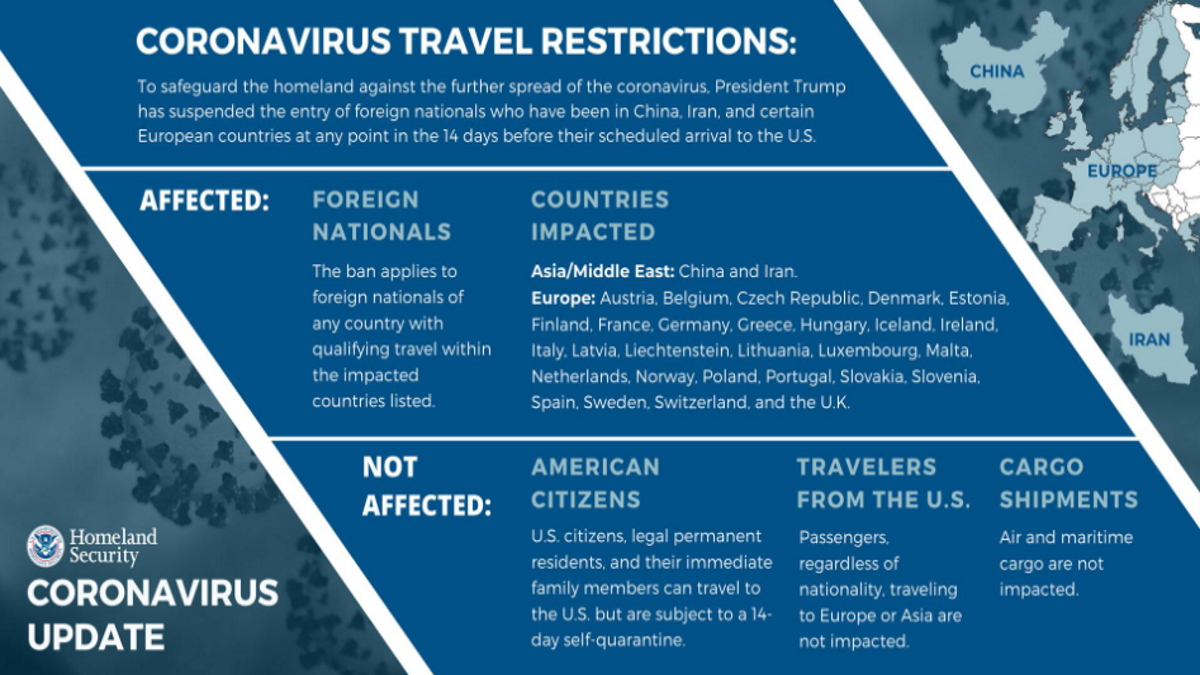
In furtherance of Presidential Proclamations 998499929993, and 9994, which bans the entry of non-U.S. citizens who are from or recently been in China, Iran, or certain European countries, the Department of Homeland Security issued a Notice of Arrival Restrictions requiring American citizens, legal permanent residents, and their immediate families who are returning home to the U.S. to travel through one of 13 airports upon arrival to the U.S., submit to an enhanced entry screening and self-quarantine for 14 days once they reach their final destination.

On March 11, 2020, President Trump determined that the potential for widespread transmission of the coronavirus by infected individuals seeking to enter the United States threatens the security of the homeland.  The President issued Proclamations 9984, 9992, and 9993, which suspends entry to nearly all foreign nationals who have been in China, Iran, and certain European countries at any point during the 14 days prior to their scheduled travel to the U.S.

These European countries include: Austria, Belgium, Czech Republic, Denmark, Estonia, Finland, France, Germany, Greece, Hungary, Iceland, Ireland, Italy, Latvia, Liechtenstein, Lithuania, Luxembourg, Malta, Netherlands, Norway, Poland, Portugal, Slovakia, Slovenia, Spain, Sweden, Switzerland, and the United Kingdom.

The order is now effective. Americans returning from the affected countries will now be required to travel through 13 airports:

  • Boston-Logan International Airport (BOS), Massachusetts
  • Chicago O’Hare International Airport (ORD), Illinois
  • Dallas/Fort Worth International Airport (DFW), Texas
  • Detroit Metropolitan Airport (DTW), Michigan
  • Daniel K. Inouye International Airport (HNL), Hawaii
  • Hartsfield-Jackson Atlanta International Airport (ATL), Georgia
  • John F. Kennedy International Airport (JFK), New York
  • Los Angeles International Airport, (LAX), California
  • Miami International Airport (MIA), Florida
  • Newark Liberty International Airport (EWR), New Jersey
  • San Francisco International Airport (SFO), California
  • Seattle-Tacoma International Airport (SEA), Washington
  • Washington-Dulles International Airport (IAD), Virginia

Upon arrival, travelers will proceed to standard customs processing. They will then continue to an enhanced entry screening where the passenger will be asked about their medical history, current condition, and asked for contact information for local health authorities.  Additionally, some passengers will have their temperature taken.

After the enhanced entry screening is complete, passengers will be given written guidance about COVID-19 and be allowed to proceed to their final destination.

Once home, individuals must immediately self-quarantine in their home and monitor their health in accordance with CDC best practices.

In order to ensure compliance, local and State public health officials will contact individuals in the days and weeks following their arrival.

DHS.gov (March, 2020) Fact Sheet: DHS Notice of Arrival Restrictions on China, Iran and Certain Countries of Europe

Northcom Commander Calls for 21st Century Tools to Defeat Current Threats


The U.S. Northern Command is responsible for defending the homeland and is morphing to develop 21st century tools to defend against 21st century threats

“Our adversaries have watched, learned and invested to offset our strengths while exploiting our weaknesses,” Air Force Gen. Terrence J. O’Shaughnessy told the House Armed Services Committee today. “They have demonstrated patterns of behavior that indicate their capability, capacity and intent to hold our homeland at risk below the nuclear threshold.”

The security environment is changing. “The Arctic is no longer a fortress wall, and the oceans are no longer protective moats,” the general said.

“They are now avenues of approach to the homeland, which highlights the increase in adversary presence in the Arctic.”

The country needs a capable, persistent defense that can deter adversaries, protect critical infrastructure, enable power projection forward and prevent homeland vulnerabilities, he said. “To deter, detect and defeat threats arrayed against the homeland today, Northcom and NORAD are transforming our commands and our way of thinking,” the general told the House committee. “We cannot defend the nation against 21st century threats with 20th century technology.” 

O’Shaughnessy called for a layered defense infused with the latest technology. The command will continue to partner with the U.S. defense and commercial industries a “to transform rapidly evolving scientific information into leading-edge digital age technology,” he said. 

The command is building a SHIELD — the Strategic Home and Integrated Ecosystem for Layered Defense — to defend the homeland.

“Our layered defense needs to establish awareness in all domains; from below the oceans to the highest levels of space, including the unseen cyber domain, which are all at risk,” he said. 

The general called for a layered sensing grid in all domains which can detect and track threats from their points of origin. “In other words, it requires the ability to identify and eliminate the archers before the arrows are released,” O’Shaughnessy said. “We need an adaptive architecture for joint all-domain command and control, capable of using a myriad of sensors across the globe into accurate decision quality threat information at the speed of relevance for effective command and control.”

Finally, the command needs the ability to deploy “defeat mechanisms capable of neutralizing advanced weapon systems in order to defend our great homeland,” he said. “We have put great effort into these areas such as Ballistic Missile Defense and the need also exists to aggressively defeat additional threats to include the ever growing cyber threat and the cruise missile threat.”

Defense.gov (March, 2020) Northcom Commander Calls for 21st Century Tools to Defeat Current Threats

DOD Officials Explain New Coronavirus Domestic Travel Restrictions


Defense officials announced restrictions on domestic travel yesterday for service members, Defense Department employees and family members in response to the new coronavirus, or COVID-19.

Deputy Defense Secretary David L. Norquist signed a memorandum halting all domestic travel, to include permanent changes of station and temporary duty travel. The ban is in effect from March 16 to May 11, 2020.

Officials speaking on background said the new memo said that service members will only be authorized local leave only.

The ban is in addition to restrictions on all DOD military and civilian personnel and their families traveling to, from, or through areas for which the Centers for Disease Control and Prevention have issued a Level 3 Travel Health Notice. That policy also stops PCS and TDY travel through May.

There are exceptions for hardship, mission essential and humanitarian travel, but those exceptions must be approved. Domestic travel for medical treatment is excluded from the ban. 

There are 10 service members who have tested positive for COVID-19. One DOD civilian and two DOD contractors have the virus, as do eight family members, officials said. There are 13 DOD laboratories that can test samples for the virus.

The officials said the new policy is aimed at preventing the spread of coronavirus. Each day tens of thousands of service members and DOD civilians are traveling. This ”strategic pause” is ”the best and safest route” to slowing the spread of the virus, they said.

The Pentagon reservation is also taking actions and raised the health protection condition in the building and associated properties to Bravo. This means all tours of the building are cancelled. Starting March 16, offices in the building will go on minimum manning, with vast numbers of employees teleworking.

Offices in the building will have rotating staffs and ”red and blue” teams. Those employees who require access to classified information to do their mission-essential tasks will work from the building, officials said.

The Pentagon will restrict access to employees with swipe card access, and will restrict international visitors. ”We are also restricting access of Pentagon officials who have been overseas in one of the CDC-defined Level 3 or 2 countries,” officials said on background. 

As of today, the Level 3 countries are: China, Iran, South Korea, Austria, Belgium, the Czech Republic, Denmark, Estonia, Finland, France, Germany, Greece, Hungary, Iceland, Italy, Latvia, Liechtenstein, Lithuania, Luxembourg, Malta, the Netherlands, Norway, Poland, Portugal, Slovakia, Slovenia, Spain, Sweden, Switzerland, Monaco, San Marino and Vatican City.

Personnel who return from these countries will be required to self-isolate for 14 days before being allowed back to work, officials said.

Pentagon officials are also closing employee fitness centers and said they are looking at other measures to lessen the chances of transmission.

Defense.gov (March, 2020) DOD Officials Explain New Coronavirus Domestic Travel Restrictions

INTERPOL warns of financial fraud linked to COVID-19

INTERPOL is encouraging the public to exercise caution when buying medical supplies online during the current health crisis, with criminals capitalizing on the situation to run a range of financial scams.


Criminals taking advantage of coronavirus anxiety to defraud victims online

INTERPOL is encouraging the public to exercise caution when buying medical supplies online during the current health crisis, with criminals capitalizing on the situation to run a range of financial scams.

With surgical masks and other medical supplies in high demand yet difficult to find in retail stores as a result of the COVID-19 pandemic, fake shops, websites, social media accounts and email addresses claiming to sell these items have sprung up online.

But instead of receiving the promised masks and supplies, unsuspecting victims have seen their money disappear into the hands of the criminals involved.

This is one of several types of financial fraud schemes connected to the ongoing global health crisis which have been reported to INTERPOL by authorities in its member countries.

COVID-19 fraud schemes

Scams linked to the virus include:

  • Telephone fraud – criminals call victims pretending to be clinic or hospital officials, who claim that a relative of the victim has fallen sick with the virus and request payments for medical treatment;
  • Phishing – emails claiming to be from national or global health authorities, with the aim of tricking victims to provide personal credentials or payment details, or to open an attachment containing malware.

In many cases, the fraudsters impersonate legitimate companies, using similar names, websites and email addresses in their attempt to trick unsuspecting members of the public, even reaching out proactively via emails and messages on social media platforms.

“Criminals are exploiting the fear and uncertainty created by COVID-19 to prey on innocent citizens who are only looking to protect their health and that of their loved ones,” said INTERPOL Secretary General Jürgen Stock.

“Anyone who is thinking of buying medical supplies online should take a moment and verify that you are in fact dealing with a legitimate, reputable company, otherwise your money could be lost to unscrupulous criminals,” concluded the INTERPOL Chief.

Blocking and recovering fraudulent payments

Monetary loses reported to INTERPOL have been as high as hundreds of thousands of dollars in a single case, and these crimes are crossing international borders.

INTERPOL’s Financial Crimes Unit is receiving information from member countries on a near-daily basis regarding fraud cases and requests to assist with stopping fraudulent payments. Targeted victims have primarily been located in Asia, but the criminals have used bank accounts located in other regions such as Europe, to appear as legitimate accounts linked to the company which is being impersonated.

In one case, a victim in Asia made payments to several bank accounts unknowingly controlled by criminals in multiple European countries. With INTERPOL’s assistance, national authorities were able to block some of the payments, but others were quickly transferred by the criminals to second and even third bank accounts before they could be traced and blocked.

To date, INTERPOL has assisted with some 30 COVID-19 related fraud scam cases with links to Asia and Europe, leading to the blocking of 18 bank accounts and freezing of more than USD 730,000 in suspected fraudulent transactions.

INTERPOL has also issued a Purple Notice alerting police in all its 194 member countries to this new type of fraud.

Warning signs

If you are looking to buy medical supplies online, or receive emails or links offering medical support, be alert to the signs of a potential scam to protect yourself and your money.

  • Independently verify the company/individual offering the items before making any purchases;
  • Be aware of bogus websites – criminals will often use a web address which looks almost identical to the legitimate one, e.g. ‘abc.org’ instead of ‘abc.com’;
  • Check online reviews of a company before making a purchase – for example, have there been complaints of other customers not receiving the promised items?;
  • Be wary if asked to make a payment to a bank account located in a different country than where the company is located;
  • If you believe you have been the victim of fraud, alert your bank immediately so the payment can be stopped.
  • Do not click on links or open attachments which you were not expecting to receive, or come from an unknown sender;
  • Be wary of unsolicited emails offering medical equipment or requesting your personal information for medical checks – legitimate health authorities do not normally contact the general public in this manner.

Interpol.int (March, 2020) INTERPOL warns of financial fraud linked to COVID-19