Raising the Global Travel Security Bar: DHS Announces New Travel Restrictions on Six Countries and Updated Process for Evaluating Foreign Country Compliance

U.S. Department of Homeland Security (DHS) Acting Secretary Chad F. Wolf announced that President Donald J. Trump signed a proclamation, which places new, tailored visa restrictions on six countries that failed to meet a series of security criteria, demonstrating that they could be a risk to the homeland.


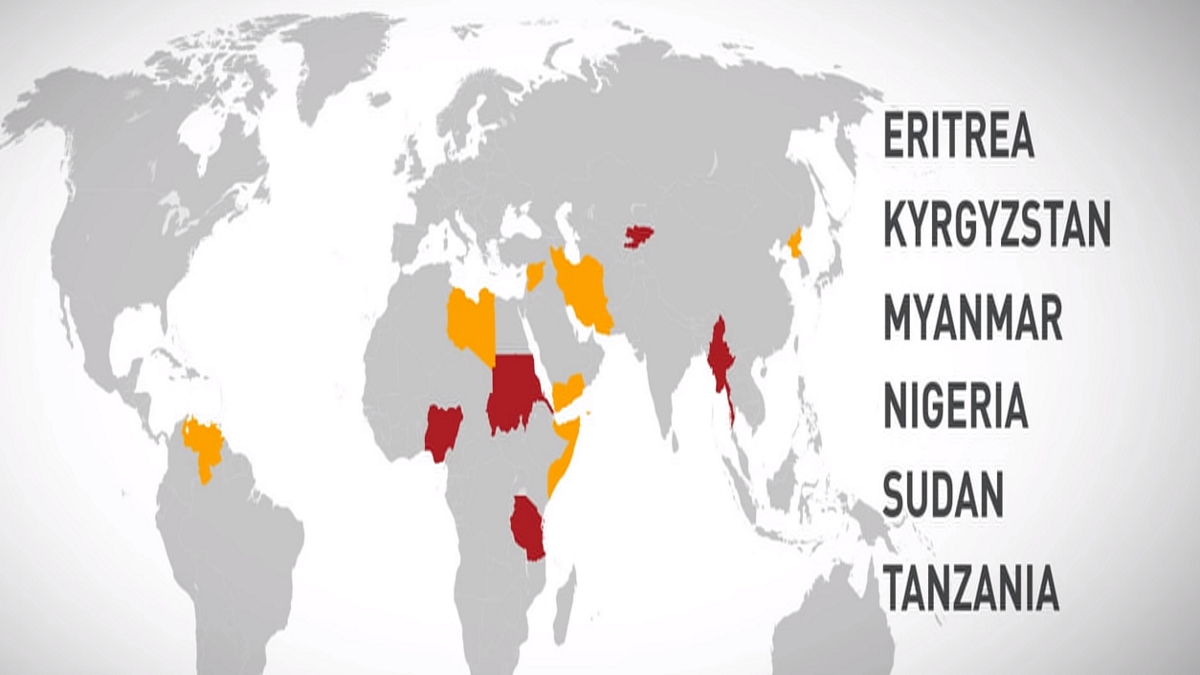
Burma, Eritrea, Kyrgyzstan, Nigeria, Sudan, Tanzania Will Face New Restrictions

Today, U.S. Department of Homeland Security (DHS) Acting Secretary Chad F. Wolf announced that President Donald J. Trump signed a proclamation, which places new, tailored visa restrictions on six countries that failed to meet a series of security criteria, demonstrating that they could be a risk to the homeland.

Acting Secretary Wolf also announced that the Department has updated the methodology it uses to assess compliance with the security criteria established under Executive Order 13780 in 2017.

This enhanced review process raises the bar for global security by requiring nations to meet the Department’s stronger security standards and by making it clear to countries what they must do to meet those standards. The updated criteria enhance our screening and vetting capabilities and allow DHS to better identify terrorists and criminals attempting to enter the United States.

“The top responsibility of the President and the Department of Homeland Security is the safety and security of the American people, and these new vetting criteria accomplish that goal and are raising the bar for global security,” said Acting Secretary Wolf. “It is logical and essential to thoroughly screen and vet everyone seeking to travel or immigrate to the United States.

Soffe Men’s 3 Pack-USA Poly Cotton Military Tee

However, there are some countries from which the U.S. does not receive the necessary information about its travelers and, as a result, pose a national security or public safety risk that warrants tailored travel restrictions.”

Wolf continued: “DHS has refined its robust security standards, including enhanced screening and vetting capabilities that allow us to better identify terrorists and criminals attempting to enter the United States. These screening and vetting capabilities are most effective when foreign governments contribute to our ability to verify a traveler’s identity and assess whether they pose a national security or public safety risk. For a small number of countries that lack either the will or the capability to adhere to these criteria, certain travel restrictions have become necessary to mitigate potential threats. The new, additional restrictions are not blanket restrictions. These tailored restrictions will make the U.S. safer and more secure. And countries that make the necessary improvements will have their restrictions removed accordingly, as was done in 2018.”

About the Refined Methodology

Pursuant to Executive Order 13780, DHS established identity-management, information sharing, national security, and public safety risk criteria all foreign governments are expected to adhere to in order to facilitate accurate and fair admissibility decisions under the Immigration and Nationality Act.

In its most recent review, DHS, in consultation with other departments and agencies, updated the methodology by which it reviews a foreign government’s performance. The update included refining and modifying specific performance metrics for each criteria, collecting additional data on foreign practices, and weighting criteria based on their degree of significance to U.S. national security. For example, DHS now considers whether a foreign government reports lost and stolen passports at least every 30 days, instead of considering whether they have ever shared such information. By reporting regularly, DHS officers can determine passport validity with higher confidence.

These changes give DHS a more detailed picture of a country’s compliance with the individual criteria and to hold them accountable for regular cooperation. In doing so, the updated methodology helps guide U.S. government discussions with foreign governments. Since implementing these measures, the Administration has recorded improvements in identity management and information sharing with multiple foreign governments, and because of this Administration’s actions, our international partners have raised their own baseline requirements.

About the New Restrictions

The Acting Secretary, in coordination with the Secretary of State, Attorney General, and Director of National Intelligence has conducted the fourth review required by Proclamation 9645. After further coordination with the other members of the cabinet and the National Security Council, the Acting Secretary submitted his recommendations to the President on September 13, 2019.

The travel restrictions imposed by the President today are tailored to the country-specific deficiencies identified during the review process and an assessment of travel-related risk. The new restrictions imposed by the President are less restrictive than the existing restrictions. Like the seven countries that continue to face travel restrictions pursuant to Proclamation 9645, the six additional countries added for restrictions are among the worst performing in the world; however, there are prospects for near-term improvement for these six countries. Each has a functioning government and each maintains productive relations with the United States. In each case and consistent with those restrictions imposed in 2017, the President has imposed specific travel restrictions to mitigate the risks posed. The restrictions imposed by this proclamation reflect the U.S. government’s greater confidence that these countries can make meaningful improvements in a reasonable period of time.

If that expectation is met, the President may remove travel restrictions at any time. Conversely, the President has also determined that if improvements are not made, additional restrictions may be added. Those travelers who have already been issued visas by the U.S. government will not be affected by the new restrictions.

Newly Imposed Restrictions

Burma: Burma has begun to engage with the United States on a variety of identity-management and information-sharing issues, but it does not comply with the established identity-management and information-sharing criteria assessed by the performance metrics.

Suspension of entry for Immigrants, except as Special Immigrants whose eligibility is based on having provided assistance to the U.S. Government.

Eritrea: Eritrea does not comply with the established identity-management and information-sharing criteria assessed by the performance metrics.

Suspension of entry for Immigrants, except as Special Immigrants whose eligibility is based on having provided assistance to the U.S. Government.

Kyrgyzstan: Kyrgyzstan does not comply with the established identity-management and information-sharing criteria assessed by the performance metrics.

Suspension of entry for Immigrants, except as Special Immigrants whose eligibility is based on having provided assistance to the U.S. Government.

Nigeria: Nigeria does not comply with the established identity-management and information-sharing criteria assessed by the performance metrics.

Suspension of entry for Immigrants, except as Special Immigrants whose eligibility is based on having provided assistance to the U.S. Government.

Sudan: Sudan generally does not comply with our identity management performance metrics and presents a high risk, relative to other countries in the world, of terrorist travel to the United States.

Suspension of entry for Diversity Immigrants, as described in section 203(c) of the INA, 8 U.S.C. 1153(c).

Tanzania: Tanzania does not comply with the established identity-management and information-sharing criteria assessed by the performance metrics.

Suspension of entry for Diversity Immigrants, as described in section 203(c) of the INA, 8 U.S.C. 1153(c).

The remarks as prepared can be found here: www.dhs.gov/news/2020/01/31/2020-travelvisa-restrictions

DHS.gov (February, 2020)  Raising the Global Travel Security Bar: DHS Announces New Travel Restrictions on Six Countries and Updated Process for Evaluating Foreign Country Compliance
Collegeville Man Indicted for Scheme to Sell Fraudulent Canine Cancer-Curing Drugs to Pet Owners

United States Attorney William M. McSwain announced that Jonathan Nyce, 70, of Collegeville, PA, was charged by Indictment with wire fraud and the interstate shipment of misbranded animal drugs.


The defendant promised to restore the health of terminally ill dogs and allegedly defrauded pet owners of hundreds of thousands of dollars

United States Attorney William M. McSwain announced that Jonathan Nyce, 70, of Collegeville, PA, was charged by Indictment with wire fraud and the interstate shipment of misbranded animal drugs. The charges arise from a years-long scheme to defraud pet owners of money by falsely claiming to sell canine cancer-curing drugs.

The Indictment alleges that the defendant created several companies beginning in 2012, including “Canine Care,” “ACGT,” and “CAGT,” through which he purported to develop drugs intended to treat cancer in dogs. Using various websites for these companies, the defendant marketed these “cancer-curing” medications to desperate pet owners, using the drug names “Tumexal” and “Naturasone.”

Soffe Men’s 3 Pack-USA Poly Cotton Military Tee

The websites made numerous allegedly false and fraudulent claims regarding the safety and efficacy of these supposed drugs, including that “Tumexal is effective against a wide variety of cancers,” and, “[i]n fact, Tumexal will almost always restore a cancer-stricken dog’s appetite, spirit and energy!” As alleged, these drugs were nothing more than a collection of bulk ingredients from various sources, which the defendant blended together himself at a facility on Arcola Road in Collegeville.

Further, through email and telephone conversations, Nyce allegedly induced the owners of terminally ill dogs to pay him hundreds or thousands of dollars for these drugs by touting the effectiveness of his products in treating a host of canine cancers. He also told prospective customers that their pets could become part of clinical trials, but in order to do so, they had to pay him large sums of money.

The defendant’s marketing, sale, and shipment of these drugs in interstate commerce is alleged to have violated the Food and Drug Administration’s Federal Food, Drug, and Cosmetic Act because the drugs were not approved by the FDA. The defendant even falsely claimed in promotional materials that his company’s research was “funded in part by the U.S. Food and Drug Administration.”

“The defendant’s alleged conduct here is shameful,” said U.S. Attorney McSwain. “As any dog owner will tell you – myself included – pets quickly become part of the family. And when they become sick, caring owners look for hope, often doing everything they can to keep their beloved pets alive and well. The defendant is charged with taking advantage of that nurturing instinct in the worst way possible by defrauding pet owners and giving them false hope that they might be able to save their dying pet. That is both cruel and illegal, and now the defendant will face the consequences.”

“American pet owners rely on the FDA to ensure their pets’ drugs are safe and effective,” said Special Agent in Charge Mark McCormack, FDA Office of Criminal Investigations’ Metro Washington Field Office.  “We will continue to investigate and bring to justice those who ignore or attempt to circumvent the law.”

If convicted, the defendant faces a maximum possible sentence of 32 years imprisonment and a fine of up to $1,250,000.

The case was investigated by the Food and Drug Administration’s Office of Criminal Investigation, and is being prosecuted by Assistant United States Attorney Christopher E. Parisi.

An indictment, information, or criminal complaint is an accusation. A defendant is presumed innocent unless and until proven guilty.

FDA.gov (February, 2020)  Collegeville Man Indicted for Scheme to Sell Fraudulent Canine Cancer-Curing Drugs to Pet Owners

 Help me maintain this news reporting blog by donating here.

Tampa Felon, Previously Convicted of Attempted Murder, Pleads Guilty to Drug and Firearms Charges

Tampa, Florida – DeShawn Torrell Salley (49, Tampa) today pleaded guilty to distributing at least 50 grams of methamphetamine, possessing a firearm in furtherance of a drug trafficking crime, and possessing a firearm


Tampa, Florida – DeShawn Torrell Salley (49, Tampa) today pleaded guilty to distributing at least 50 grams of methamphetamine, possessing a firearm in furtherance of a drug trafficking crime, and possessing a firearm as a convicted felon. He faces a mandatory minimum term of 15 years, and up to life, in federal prison. A sentencing date has not yet been set.

According to the plea agreement, between 1999 and 2004, Salley was convicted of six felony offenses, including attempted murder in the first degree. On June 5, 2019, he sold 54 grams of methamphetamine to a confidential informant in Tampa.

On July 31, 2019, federal agents arrested Salley. During the execution of a search warrant at Salley’s apartment, federal agents recovered a loaded Glock .45 caliber pistol, a bulletproof vest, heroin, and marijuana. 

This case was investigated by the Bureau of Alcohol, Tobacco, Firearms and Explosives, the Drug Enforcement Administration, the Tampa Police Department, and the Hillsborough County Sheriff’s Office. It is being prosecuted by Assistant United States Attorney Christopher F. Murray.

This is another case prosecuted as part of the Department of Justice’s “Project Safe Neighborhoods” Program (PSN), which is a nationwide, crime reduction strategy aimed at decreasing violent crime in communities. It involves a comprehensive approach to public safety — one that includes investigating and prosecuting crimes, along with prevention and reentry efforts. In the Middle District of Florida, U.S. Attorney Maria Chapa Lopez coordinates PSN efforts in cooperation with various federal, state, and local law enforcement officials.

ATF.gov (February, 2020) Tampa Felon, Previously Convicted of Attempted Murder, Pleads Guilty to Drug and Firearms Charges

 Help me maintain this news reporting blog by donating here.

American Contractor Kidnapped by Taliban in Afghanistan

Newsweek has reported that an American contractor was captured by Taliban-aligned militants in Afghanistan last week, prompting a nation-wide rescue effort.


Newsweek has reported that an American contractor was captured by Taliban-aligned militants in Afghanistan last week, prompting a nation-wide rescue effort.

Mark R. Frerichs of Lombard, Illinois, was kidnapped last Friday in Khost, a province located in the southeastern part of the country that borders the Federally Administered Tribal Areas, an underdeveloped region between Afghanistan and Pakistan, U.S. officials told Newsweek, who spoke on condition of anonymity because they were not authorized to discuss the details publicly.

Newsweek went on to report:

Frerichs, 57, is a former U.S. Navy diver and the managing director for International Logistical Support, a U.S. government contractor. According to his LinkedIn account, he has worked as a civil engineer in several conflict zones from Iraq to Sudan during the past 10 years, where he has consulted on logistical contracts for both governments and non-governmental organizations. U.S. officials told Newsweek Frerichs had regularly traveled to Afghanistan since 2012.

While no group has claimed responsibility for the kidnapping, U.S. officials believe the Taliban-aligned Haqqani network orchestrated the operation. Newsweek was unable to determine exactly how Frerichs was captured, but efforts to locate and recover him include a joint effort by Departments of State and Defense, along with the Federal Bureau of Investigation. If hostage rescue becomes an option for military commanders, typically the mission would be given to U.S. special operation forces.

During the past few days, American forces carried out both ground and intelligence-gathering operations to track the whereabouts of Frerichs while navigating difficult Afghan topography and severe winter weather that has prevented overhead surveillance missions by U.S. military drones.

Newsweek first learned about the kidnapping on Monday. The Hostage Recovery Fusion Cell, a multi-agency team based at FBI Headquarters in Washington, D.C., asked Newsweek to hold the story until efforts to recover Frerichs progressed, and the publication agreed.

“The welfare and safety of U.S. citizens abroad is one of the highest priorities of the Department of State,” said Holly Jensen, a spokeswoman for the Hostage Recovery Fusion Cell. “We have no further comment.”

A Defense Department spokesman referred questions to the State Department.

Newsweek.com (February, 2020) EXCLUSIVE: U.S. CITIZEN KIDNAPPED BY TALIBAN GROUP IN AFGHANISTAN

 Help me maintain this news reporting blog by donating here.

Former Employee of Walter Reed National Military Medical Center Facing Federal Indictment in Maryland

A federal grand jury has indicted David Laufer, age 63, of Pittsburgh, Pennsylvania, formerly of Bethesda, Maryland, on five counts of the federal charge of making false statements.


Allegedly Failed to Report Financial Benefits He Received from Individuals and Companies Doing Business with Walter Reed

A federal grand jury has indicted David Laufer, age 63, of Pittsburgh, Pennsylvania, formerly of Bethesda, Maryland, on five counts of the federal charge of making false statements.

The indictment was returned on December 16, 2019, and was unsealed upon his arrest on January 28, 2020. Laufer had his initial appearance yesterday in U.S. District Court in Greenbelt and was released pending trial.

The indictment was announced by United States Attorney for the District of Maryland Robert K. Hur; Special Agent in Charge Robert E. Craig, Jr. of the Defense Criminal Investigative Service -Mid-Atlantic Field Office; and Special Agent in Charge Maureen Dixon, Office of Investigations, and Office of Inspector General of the Department of Health and Human Services.

According to the indictment, until May 2019, Laufer worked as the Chief of the Prosthetics and Orthotics Department at Walter Reed National Military Medical Center, the largest joint military medical center in the United States.

Walter Reed is located in Bethesda and provides medical services, including orthotic and prosthetic services to U.S. service members and their dependents, including wounded soldiers.

Laufer’s job required him to complete annual Confidential Financial Disclosure forms which required him to report: all sources of outside income greater than $200; any business outside the U.S. Government in which Laufer or his spouse was an employee or consultant, whether or not compensated; any agreements or arrangements concerning past, current, and future employment; and travel-related reimbursement or other gifts totaling more than $350 from any one source during the reporting period.

The indictment alleges that Laufer failed to report financial benefits he received from Person B and Company B, located in Germantown, Maryland and owned, operated, and controlled by Person B. Company B provided prosthetics and orthotics materials to Walter Reed in return for payments from the government.

According to the indictment, Person B regularly interacted with Laufer about Company B’s business with Walter Reed.

Furthermore, the indictment alleges that Laufer falsely told federal agents that he had never received money, gifts, or sporting event tickets from any vendor doing business before the Prosthetics and Orthotics Department when in fact Laufer had received financial benefits, including travel and sporting event tickets, from Person Band Company B.

DODIG.mil (February, 2020) Former Employee of Walter Reed National Military Medical Center Facing Federal Indictment in Maryland

 Help me maintain this news reporting blog by donating here.